
The healthcare scenario seems simple. A patient walks into the clinic, meets the provider, answers a few questions, receives treatment, and then goes home. But behind the scenes, once that appointment ends, a completely different kind of billing challenge begins, especially in time-based therapy services; things get complicated fast. And one important medical billing rule that confuses everyone is the 8-minute rule. This single rule causes more claim denials, underbilling, and compliance headaches than almost any other time-based billing requirement. Physical therapy clinics, occupational therapy providers, and chiropractic offices deal with it daily, yet many still misunderstand how it actually works. And never think that getting it wrong means losing a few dollars. It can mean revenue leakage, audit risk, compliance violations, and serious financial strain on your practice.
What Is the 8-Minute Rule?
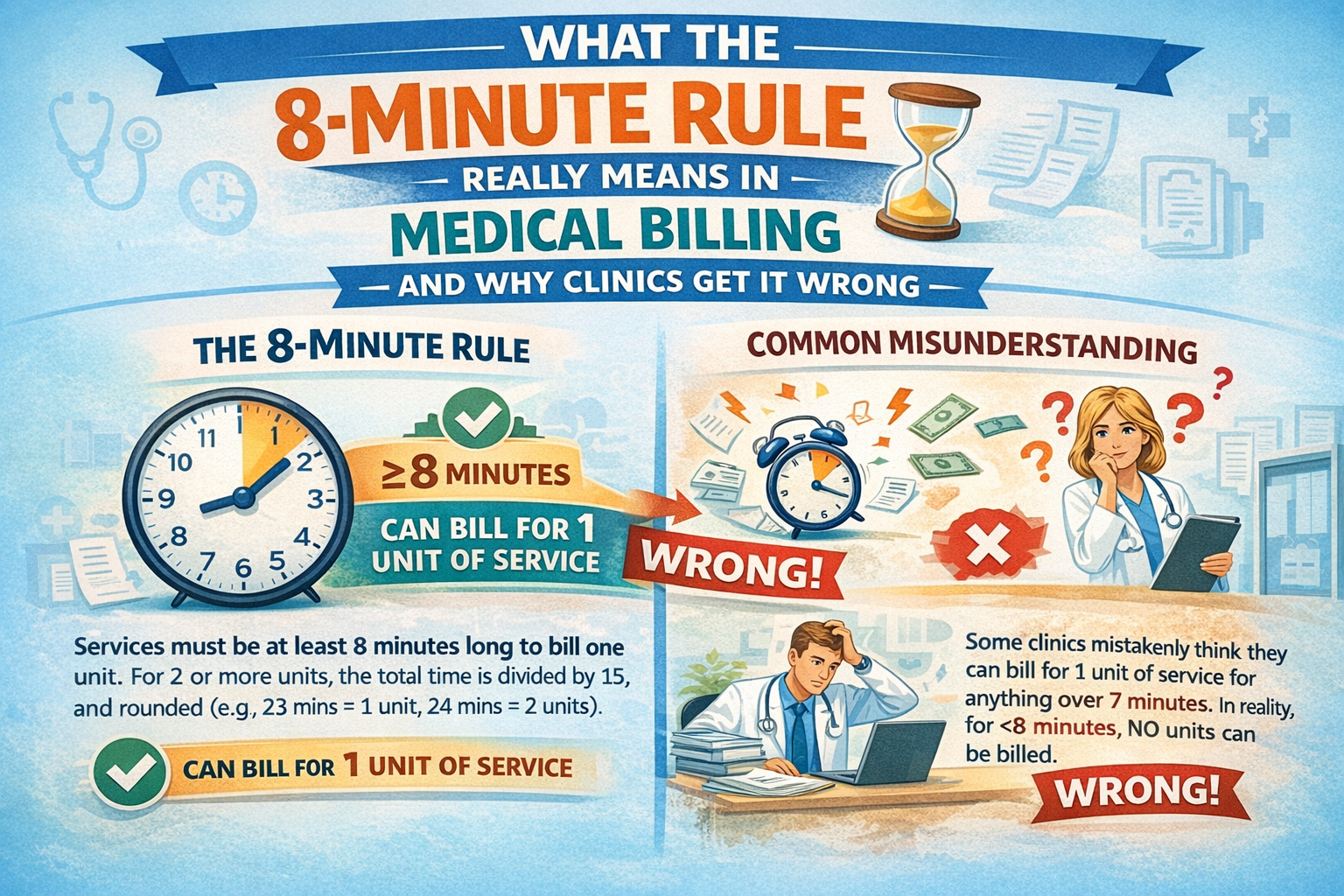
The 8-minute rule is a Medicare billing guideline that determines how many billable units a provider can report for time-based CPT codes. It applies specifically to timed services like
- Physical therapy billing
- Occupational therapy billing
- Speech therapy billing
- Certain chiropractic services
Those that are typically billed in 15-minute increments. If you’re providing therapeutic exercises, neuromuscular reeducation, manual therapy, gait training, or therapeutic activities, you’re dealing with timed CPT codes. Under Medicare guidelines, you must provide at least eight minutes of a timed service to bill one unit. That’s where the rule gets its name. It’s not just about hitting 8 minutes. It’s about how total treatment time converts into billable units when multiple time-based services are provided during a session. But this is the place where many providers stop reading and assume they understand it completely. Unfortunately, that partial understanding leads to errors.
Understanding Timed CPT Codes – The Foundation of the Rule
It’s really important first to clarify the need for the 8-minute rule. The 8-minute rule only applies to timed CPT codes, not untimed codes. Timed CPT codes are typically billed in 15-minute increments. Examples include:
- 97110: Therapeutic exercises
- 97112: Neuromuscular reeducation
- 97140: Manual therapy
- 97530: Therapeutic activities
- 97116: Gait training
Evaluations and other untimed codes are billed as a single unit regardless of time.
This major difference is crucial because mixing timed and untimed codes incorrectly is one of the biggest compliance mistakes practices make.
How the 8-Minute Rule Actually Works
The 8-minute rule does not mean that every service performed for eight minutes automatically qualifies for its own billable unit. Instead, Medicare requires providers to add up the total timed minutes for all timed services delivered during a single session and then convert that total time into billable units using a specific time range chart. For example:
- 8–22 minutes = 1 unit
- 23–37 minutes = 2 units
- 38–52 minutes = 3 units
- 53–67 minutes = 4 units
- 68–82 minutes = 5 units
And so on.
In increments of fifteen minutes, this pattern continues. The problem is that the number of units is determined by the entire amount of time spent, not by the amount of time spent on each CPT code separately. Let’s understand it more clearly with a simple example.
A patient receives:
- 10 minutes of therapeutic exercise coded as 97110
- 10 minutes of manual therapy coded as 97140
- 10 minutes of neuromuscular reeducation coded as 97112
Due to the fact that each service exceeded the eight-minute limit, many clinics mistakenly bill three units. However, Medicare does not calculate it in that way. According to the Medicare 8-minute rule, those thirty total minutes only equals two billable units. The units must then be distributed according to the services that consumed the most time. Clinical judgment and clear documentation become crucial if time is divided equally. In therapeutic settings, this misconception alone can lead to a considerable number of billing problems.
Why Clinics Get the 8-Minute Rule Wrong
Most billing errors aren’t intentional. They happen because clinics are overwhelmed, understaffed, or working with outdated systems.
Here are the most common issues we see at Revantage Billing.
Billing Each Code Separately Instead of Combining Time
This is the number one mistake.
Providers often think:
Every code that hits 8 minutes earns its own unit. That’s not how Medicare calculates it.
You must:
- Add total timed minutes.
- Convert that total into units.
- Allocate units based on the services performed.
If you skip that middle step, you’ll face an overbilling risk.
Not Tracking Exact Minutes
Rounding can be dangerous. If your documentation is not clear and contains phrases like:
“Approximately 15 minutes of manual therapy” or “about 10 minutes” creates ambiguity.
Auditors want to see exact time documentation, and ambiguity works against the provider. They want defensible records that show exactly how many minutes were spent on each timed CPT code and how the total timed minutes support the billed units. If time isn’t clearly documented, that unit can be denied. And if it happens repeatedly, then it becomes a compliance concern. Medical billing compliance depends heavily on that alignment between treatment notes and claims data.
Confusing Medicare Rules with Commercial Insurance Rules
Confusion becomes even more complicated when you factor in payer differences. While Medicare follows the 8-minute rule, not every commercial insurance company applies the exact same methodology. Some use variations often referred to as the “rule of 8,” while others apply per-code time thresholds rather than total-time calculations. Without proper insurance verification and payer-specific billing knowledge, clinics can unknowingly apply Medicare rules to a commercial plan that operates differently. That mismatch frequently leads to denied claims and delayed reimbursements. That’s why insurance verification and payer policy review are critical parts of revenue cycle management.
Underbilling Due to Fear of Denials
Underbilling is just as problematic as overbilling, though it doesn’t always feel as urgent. Many clinic owners intentionally bill conservatively because they worry about compliance. According to Medicare criteria, a session that lasts 45 total timed minutes is eligible for three units; however, some clinicians charge only two units just to be safe. At that time, that feels responsible. In reality, it results in consistent revenue loss. When you multiply one missed unit per patient across dozens of patients per week, the financial impact becomes huge. A clinic seeing twenty therapy patients per day that underbills by just one thirty-dollar unit per visit could lose thousands of dollars per month. Over a year, that number becomes bigger and affects the whole practice.
Technology issues
Technology plays an important role as well. Medicare 8-minute rule calculators are integrated into certain electronic medical record systems but not in others. Even when calculators exist, they do not account for payer-specific variations. Clinics run the risk of systemic errors if they only rely on automation without conducting regular billing audits. On the other hand, clinics that attempt to calculate everything manually often introduce human error. So what’s the right way? The most effective approach combines smart software tools with experienced billing oversight.
Real-Life Example: How Small Errors Become Big Revenue Losses
Let’s consider a physical therapy clinic that sees 20 patients per day.
If they underbill just 1 unit per patient at $30 per unit…
That’s:
- $600 per day
- $3,000 per week
- $12,000 per month
- $144,000 per year
All from the simple misapplication of the 8-minute rule. That’s not a small mistake. That’s a business issue that results in great revenue loss.
Audit Success Starts Here: 8-Minute Rule Best Practices to Avoid Mistakes
Documentation Accuracy to Protect Your Clinic
If you want to see a perfect 8-minute rule documentation, it should include:
- Exact minutes per service
- Total timed minutes
- Clear link between service and patient condition
- Skilled provider involvement
- Progress toward treatment goals
Your documentation should tell the full story of why the service was medically necessary, not just how long it lasted. You have to think that if an auditor reads your note two years from now, would they clearly understand what happened during that session? If not, there’s a risk.
Manage Hidden Compliance Threat
Another aspect that isn’t given enough attention is compliance. When the 8-minute rule is used incorrectly, it leads to audits, refund requests, and payer scrutiny. Medicare billing guidelines exist for some reason and repeated inconsistencies can cause a clinic’s claims data to be reviewed. Even if errors are unintentional, repayment demands can still occur. That’s why maintaining the long-term stability of your practice is just as important as optimizing reimbursement for medical billing accuracy. A strong compliance framework confirms that every billed unit is supported by defensible documentation and aligns with payer-specific requirements.
Empower Your Team Through Ongoing Training
Education and internal training are essential components of solving this issue. Therapists should understand how total timed minutes convert into units. Before submitting claims, billing staff should confirm that the documentation supports those units. Practice managers should periodically review reports to find unusual billing patterns. For example, if every session consistently bills exactly two units without considering treatment duration, that could indicate underbilling. Similarly, if nearly every session bills high unit counts, that could cause a documentation review to ensure its compliance.
Medical Necessity Matters More Than Minutes
Another important factor in supporting time-based billing is medical necessity. Just recording minutes is insufficient. Notes must show patient progress and expert intervention. Auditors assess if the amount of time spent was reasonable and required for the patient’s condition. A claim won’t be protected by a precisely calculated unit count if the narrative documentation doesn’t show the need for professional treatment services. Strong documentation connects time, technique, and treatment goals in a clear, logical way.
How Revantage Billing Helps Clinics Get It Right
Revantage Billing is a medical billing company that provides a complete medical billing solution for your practice. With our experience, we often see clinics struggle not because they lack clinical expertise, but because revenue cycle management processes haven’t evolved alongside regulatory requirements. We understand that the 8-minute rule seems like a small technical detail, but it directly affects medical billing accuracy, insurance claim approval rates, and overall financial performance. That’s why we don’t just submit claims.
- We analyze your billing patterns.
- We review your time-based CPT coding.
- We audit documentation workflows.
- We train staff on payer-specific rules.
And most importantly, we identify where revenue is leaking. Our medical billing services include Physical therapy billing services, Occupational therapy billing support, Chiropractic billing management, Revenue cycle management, Insurance verification, Denial management, and Compliance audits. We handle the complexities of timed CPT codes and Medicare billing guidelines smoothly because that’s what we do every day.