Do you really think that running a mental health practice is just about therapy sessions, treatment plans, and helping patients feel better? If you think that, then you are wrong.
Those who have been running mental health practices know that behind every appointment, there’s paperwork. And this paperwork is incomplete without ICD-10 codes.
But don’t think that you need to memorize all of these codes for accurate coding. No doubt ICD-10 coding for mental health services can feel complicated at first. But choosing the right code from hundreds of behavioral health diagnosis codes can help you make your claims successful, receive quick reimbursements and save your practice from compliance issues.
You don’t need to know every single ICD-10 code. You just need to know the right ones and the ones that show up again and again in everyday mental health billing.
Let’s get into details and discuss the most important ICD-10 codes every mental health practice should know, explain how they’re used, and share practical billing tips to help you avoid costly mistakes.
Why ICD-10 Codes Matter in Mental Health Billing
ICD-10-CM (International Classification of Diseases, 10th Revision, Clinical Modification) codes are used to document diagnoses. In mental health billing, they tell insurance companies why a patient is receiving treatment.
Without the correct diagnosis code:
- Claims get denied.
- Payments get delayed.
- Audits become more likely.
- Compliance risks increase.
More importantly, diagnosis codes justify medical necessity. Insurance companies want proof that services like psychotherapy, psychiatric evaluations, and medication management are clinically right.
If your ICD-10 coding doesn’t align with the documentation in the chart, then it can become a problem for you and cause your claim to be denied. That’s why accurate behavioral health coding becomes essential.
Understanding the “F” Codes: The Core of Mental Health Diagnoses
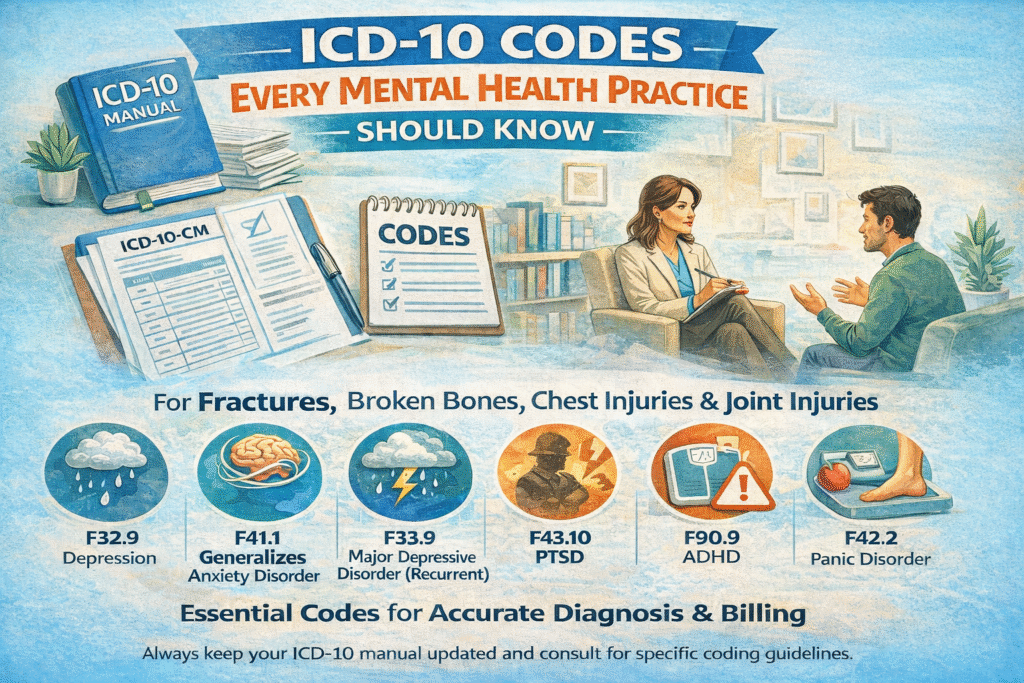
Most mental health ICD-10 codes start with the letter F. These fall under the category:
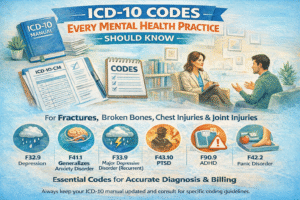
F01–F99: Mental, Behavioral, and Neurodevelopmental Disorders
Let’s see the most common ICD-10 codes often used in a mental health practice.
Depression ICD-10 Codes (F32 & F33)
Depression is one of the most common diagnoses in behavioral health. If your practice treats mood disorders and most do, you’ll use these codes constantly.
Major Depressive Disorder, Single Episode – F32 Series
Common codes include:
- F32.0 – Mild
- F32.1 – Moderate
- F32.2 – Severe without psychotic features
- F32.3 – Severe with psychotic features
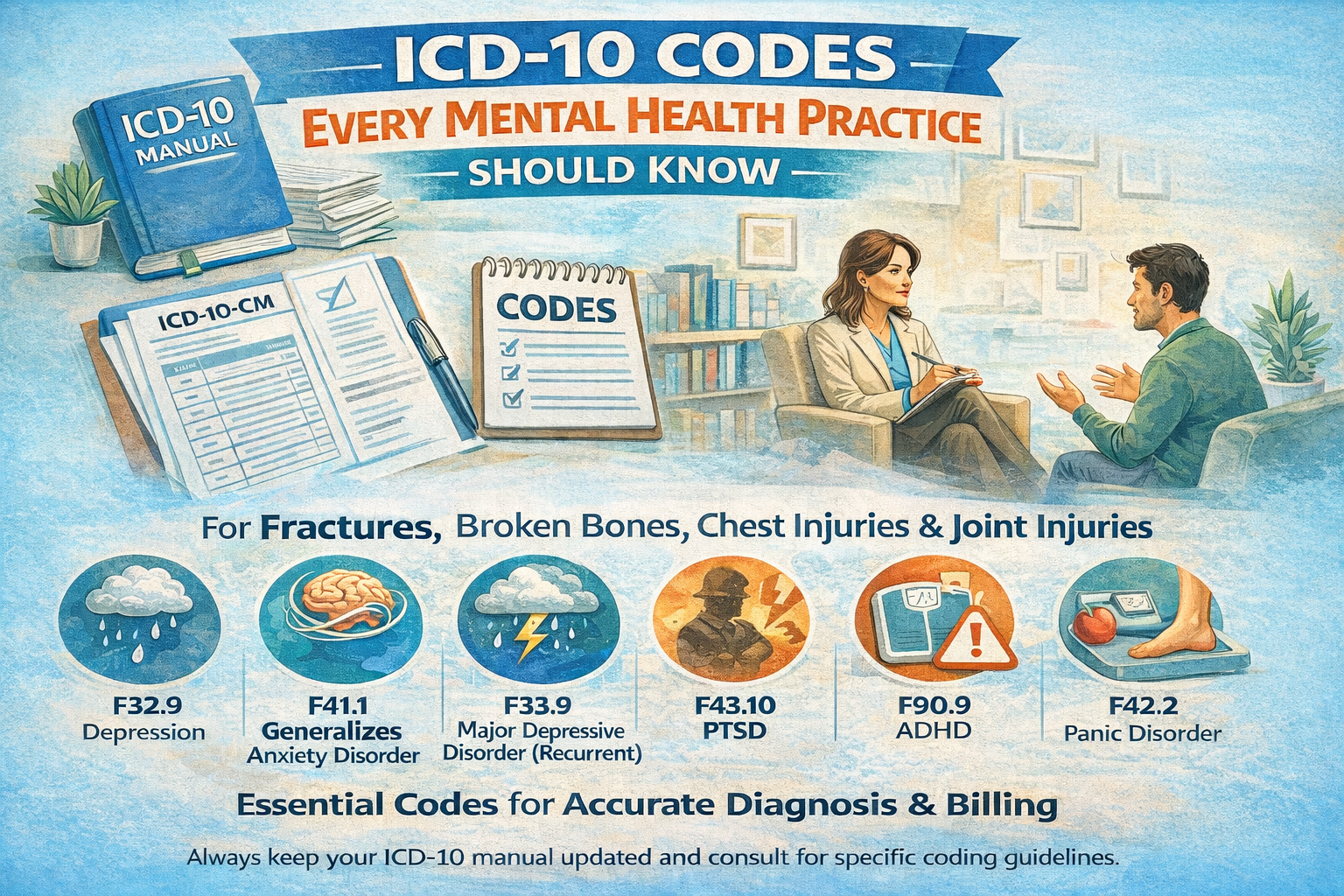
- F32.9 – Unspecified
You must understand that severity matters in this situation. Unless the documentation really does not support a more detailed code, you cannot just set the default to undefined.
An increasing number of insurance payers checked up unspecified codes. If mild symptoms and functional impairment are clearly described in your note, F32.1 is a better choice than F32.9.
Major Depressive Disorder, Recurrent – F33 Series
For patients with repeated episodes:
- F33.0 – Mild
- F33.1 – Moderate
- F33.2 – Severe without psychotic features
- F33.3 – Severe with psychotic features
- F33.9 – Unspecified
The difference between F32 and F33 is simple: single episode vs. recurrent. But if you mix them up, claims can get denied.
From a billing perspective, documenting recurrence clearly is essential. If you use words like history of previous episodes or multiple prior depressive episodes, then it should appear in the chart.
Anxiety Disorders ICD-10 Codes (F40–F41)
Anxiety disorders are another major diagnosis in mental health practices.
Generalized Anxiety Disorder – F41.1
This is probably one of the most frequently billed mental health ICD-10 codes.
To justify F41.1, documentation should reflect excessive anxiety occurring more days than not for at least six months, along with associated symptoms like restlessness or sleep disturbance.
Panic Disorder – F41.0
Used for recurrent unexpected panic attacks with ongoing concern about future attacks.
Social Anxiety Disorder – F40.10
- F40.10 – Social phobia, unspecified
- F40.11 – Social phobia, generalized
Other Anxiety Codes
- F41.8 – Other specified anxiety disorders
- F41.9 – Anxiety disorder, unspecified
Again, payers don’t love unspecified codes unless there’s a legitimate reason.
If your therapist documentation clearly describes GAD, don’t use F41.9 out of convenience. That shortcut can cost you.
Bipolar Disorder ICD-10 Codes (F31 Series)
Bipolar disorder coding gets more detailed because it depends on:
- Current episode (manic, depressive, mixed)
- Severity
- Presence of psychotic features
Some common bipolar disorder ICD-10 codes include:
- F31.9 – Bipolar disorder, unspecified
- F31.30 – Bipolar disorder, current episode depressed, unspecified
- F31.32 – Bipolar disorder, current episode depressed, moderate
- F31.81 – Bipolar II disorder
With the accuracy of bipolar coding, documentation is also very important. The provider must clearly indicate:
- Type I or II
- Current episode type
- Severity level
Without this clarification, billers are left guessing and guessing leads to errors.
PTSD and Trauma-Related Disorders (F43 Series)
Trauma-related diagnoses are increasingly common in therapy practices.
Post-Traumatic Stress Disorder – F43.10
- F43.10 – PTSD, unspecified
- F43.11 – PTSD, acute
- F43.12 – PTSD, chronic
If symptoms last more than three months, then chronic PTSD is the right choice.
Adjustment Disorders – F43.2 Series
It includes:
- F43.21 – Adjustment disorder with depressed mood
- F43.22 – Adjustment disorder with anxiety
- F43.23 – With mixed anxiety and depressed mood
- F43.25 – With disturbance of conduct
Adjustment disorder codes are often used for short-term therapy situations that are relevant to specific stressors.
But you need to be careful here because if symptoms persist beyond six months after the stressor ends, this diagnosis no longer applies.
ADHD ICD-10 Codes (F90 Series)
Attention-Deficit/Hyperactivity Disorder is common in both children and adults.
- F90.0 – ADHD, predominantly inattentive type
- F90.1 – ADHD, predominantly hyperactive type
- F90.2 – ADHD, combined type
- F90.9 – ADHD, unspecified
Payers require documentation supporting symptom onset in childhood. For adult ADHD, historical context becomes crucial.
Substance Use Disorders (F10–F19 Series)
Substance use coding is highly specific and depends on:
- Substance type
- Severity (mild, moderate, severe)
- In remission or not
Codes include:
- F10.20 – Alcohol dependence, uncomplicated
- F11.20 – Opioid dependence, uncomplicated
- F12.20 – Cannabis dependence
Behavioral health billing for substance use treatment requires precise medical coding. Using dependence when documentation only supports abuse or vice versa can create compliance issues.
Obsessive-Compulsive and Related Disorders (F42)
- F42 – Obsessive-compulsive disorder
- F42.2 – Mixed obsessional thoughts and acts
Clear documentation of intrusive thoughts and compulsive behaviors supports these codes.
Schizophrenia and Psychotic Disorders (F20–F29)
These codes are used very rarely in outpatient therapy settings but are also very critical for psychiatric practices.
- F20.9 – Schizophrenia, unspecified
- F25.0 – Schizoaffective disorder, bipolar type
- F25.1 – Schizoaffective disorder, depressive type
Psychotic disorders often involve medication management billing, so correct ICD-10 coding supports higher-level services.
Insomnia and Sleep Disorders (F51 & G47)
Mental health providers frequently treat insomnia.
- F51.01 – Primary insomnia
- F51.05 – Insomnia due to other mental disorder
- G47.00 – Insomnia, unspecified
When insomnia is secondary to depression or anxiety, then your documentation should show that relationship.
Eating Disorders (F50 Series)
- F50.0 – Anorexia nervosa
- F50.2 – Bulimia nervosa
- F50.9 – Eating disorder, unspecified
These diagnoses often require multidisciplinary documentation.
Common ICD-10 Coding Mistakes in Mental Health Practices
Coding mistakes are very common, and even experienced providers sometimes make unexpected errors. These errors include:
Overusing Unspecified Codes
F32.9 and F41.9 get overused. If documentation supports specificity, then we must use it.
Not Updating Diagnosis Over Time
If a patient moves from adjustment disorder to major depressive disorder, the ICD-10 code must change.
Mismatch Between CPT and ICD-10
Diagnosis codes must justify the level of service billed. A low-acuity diagnosis paired with high-complexity CPT codes can trigger denials.
Ignoring Comorbid Conditions
If a patient has both GAD and MDD, both should be coded when clinically relevant.
How Accurate ICD-10 Coding Improves Revenue Cycle Management
Coding is the need for smooth revenue cycle management. Accurate mental health diagnosis coding:
- Reduces claim denials
- Speeds up reimbursement
- Lowers audit risk
- Improves clean claim rates
- Strengthens compliance
For growing behavioral health practices, billing inefficiencies can disrupt your overall revenue. A small coding error not only affects one claim but it also appears in dozens of claims quickly. That’s why many practices partner with specialized mental health billing companies to manage ICD-10 coding and revenue cycle operations.
How Revantage Billing Supports Mental Health Practices
Revantage Billing is an experienced and professional medical billing company. With years of experience in handling mental health billing and coding services, we understand that mental health providers didn’t start their practice to become coding experts. They’re here to help people. And we’re here to make sure you get paid accurately and on time.
Our team specializes in:
- ICD-10 coding for behavioral health
- Claim submission and follow-up
- Denial management
- Insurance verification
- Revenue cycle optimization
We stay updated on mental health billing regulations so your practice is never left behind and remains safe from penalties. We work to make your revenue cycle management process more efficient. Remember that when your billing runs smoothly, your practice grows confidently. So outsource your mental health billing services to Reventage Billing and provide more quality time with your patients while achieving your goals.