
Quick Answer
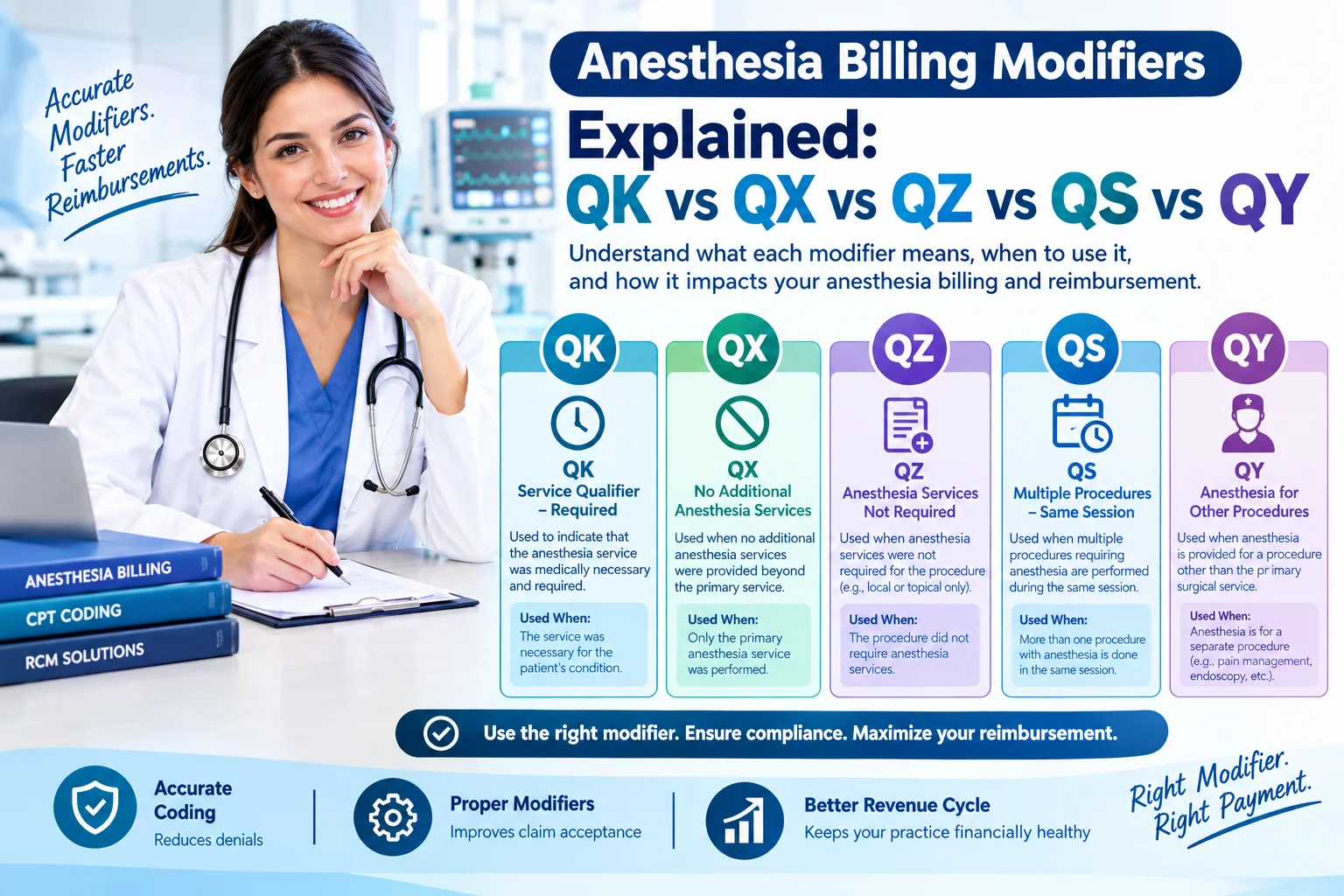
Anesthesia claims use HCPCS modifiers to tell the payer who provided the anesthesia and how the anesthesiologist was involved. QK means an anesthesiologist medically directs 2 to 4 CRNA cases at the same time, QX is used by the CRNA when working under an anesthesiologist’s medical direction. QY is used when an anesthesiologist medically directs one CRNA. All three have a 50/50 payment split. QZ means the CRNA provided the anesthesia without physician medical direction, so the CRNA is paid at 100%. QS is different because it is only an informational modifier used to show Monitored Anesthesia Care (MAC).
What Are Anesthesia Billing Modifiers?
Anesthesia modifiers are two-character codes added to an anesthesia claim to communicate circumstances surrounding the service.
Unlike an anesthesia CPT code, which identifies the type of anesthesia procedure, the modifier can provide additional information about who performed the service, whether medical direction was involved, how many concurrent procedures were being directed, or whether monitored anesthesia care was provided.
Why Anesthesia Modifiers Matter in Medical Billing
Anesthesia is different from many other areas of medicine because the CPT code does not tell the payer who provided the anesthesia or how the payment should be divided. Anesthesia CPT codes can be used by an anesthesiologist working alone, an anesthesiologist medically directing a CRNA, a CRNA working independently, or a teaching physician supervising a resident. The modifier provides the additional information the payer needs to process the claim correctly.
Using the wrong modifier can cause several problems. The claim can be denied because:
- A required modifier is missing
- It can be paid at the wrong percentage like 50% instead of 100%
- It can trigger an audit if the physician’s and CRNA’s claims show different information for the same case.
Because Medicare requires anesthesia payment modifiers on claims, knowing which modifier to use and when is an important part of anesthesia revenue cycle management.
The Anesthesia Payment Formula
Before understanding anesthesia modifiers, it helps to understand how anesthesia payment is calculated. Unlike E/M visits or many surgical CPT codes, anesthesia services are generally paid based on the number of units and a conversion factor. The basic formula is:
(Base Units + Time Units + Modifying Units) × Anesthesia Conversion Factor = Payment
- Base units are assigned to each anesthesia CPT code and show the complexity of the anesthesia service.
- Time units are based on how long the anesthesia service takes, using the time reported by the provider and the payer’s calculation method.
- Modifying units can be added for certain qualifying circumstances, such as an emergency or specific patient conditions, when applicable.
- Conversion factor is the dollar amount used to convert the total anesthesia units into a payment amount. CMS sets its Medicare conversion factor annually, while commercial payers and state Medicaid programs use their own rates.
The payment modifier (AA, QK, QX, QY, QZ, or AD) is then used to find how the calculated payment is assigned to the provider. In simple terms, the modifier generally does not change the number of anesthesia units; it tells the payer how the payment should be handled based on who provided or directed the anesthesia service.
Understanding Anesthesia Modifiers
Most anesthesia claims need a payment modifier to show who provided the anesthesia and how the service was performed. Using the wrong or missing modifier can lead to claim processing problems or incorrect payment.
| Modifier | Who Uses It | Simple Meaning | Payment |
| AA | Anesthesiologist | The anesthesiologist personally performed the entire anesthesia service. | 100% |
| QK | Anesthesiologist | The anesthesiologist medically directed 2–4 anesthesia cases at the same time. | 50% |
| QY | Anesthesiologist | The anesthesiologist medically directed one CRNA or AA. | 50% |
| QX | CRNA / AA | The provider performed the case under an anesthesiologist’s medical direction. | 50% |
| QZ | CRNA | The CRNA performed the anesthesia service without physician medical direction. | 100% |
| AD | Anesthesiologist | The anesthesiologist medically supervised more than 4 cases or did not meet all medical-direction requirements. | Limited payment based on Medicare rules |
| QS | Any anesthesia provider | Shows that Monitored Anesthesia Care (MAC) was provided. | No separate payment impact |
| GC | Teaching physician | Shows that a resident performed the case under the direction of a teaching physician. | Depends on payer rules |
CMS generally uses the term “qualified nonphysician anesthetist” in its current manual language for these rules. However, QZ is specifically defined for CRNAs and is not used for anesthesiologist assistants (AAs).
What Is Modifier QK in Anesthesia Billing?
Who bills it: The anesthesiologist.
What it means: The QK modifier is used when an anesthesiologist medically directs 2, 3, or 4 anesthesia cases at the same time. The cases must be performed by qualified nonphysician anesthetists, such as CRNAs or AAs and the anesthesiologist must meet all seven TEFRA medical-direction requirements for each case.
Payment: The physician’s claim is paid at 50% of the calculated Medicare fee schedule amount. The CRNA’s matching claim uses QX and is also paid at 50%. Together, the two claims represent the full calculated payment for the case that is divided between the providers.
Pairs with: QX on the CRNA’s claim for the same case and date of service.
Documentation checklist:
- Pre-anesthesia evaluation signed for each patient.
- Unique anesthesia plan for each case.
- Documentation of induction and emergence times and presence of anesthesiologist when required
- A directed case concurrency log or a room-by-room schedule with a maximum of four directed cases at a time
- Documentation of postanesthesia care
Common mistake: Using QK when five cases overlap, even for a short time. If the anesthesiologist has more than four concurrent cases, the services can be considered medical supervision under AD rather than medical direction.
What Is Modifier QX in Anesthesia Billing?
Who bills it: The CRNA or anesthesiologist assistant (AA).
Definition: The QX modifier is used on a CRNA or AA claim when the provider performs the anesthesia service under the medical direction of an anesthesiologist. It works as the matching modifier to the physician’s claim which can use QK for 2–4 concurrent cases or QY for one case.
Payment: The claim is paid at 50% of the calculated fee schedule amount.
Pairs with: QK or QY on the anesthesiologist’s claim for the same case.
Why it matters: The CRNA/AA and anesthesiologist submit separate claims, sometimes through different billing entities. Payers can compare the claims to make sure the information is consistent. Differences in date of service, concurrency, modifiers or supporting documentation can lead to claim delays, denials or later reviews.
Common mistake: Billing QX without a matching physician claim that supports medical direction. For example, if the physician’s claim does not meet the medical-direction requirements and is later changed to AD, the CRNA’s QX claim also needs to be reviewed or reprocessed.
What Is Modifier QZ in Anesthesia Billing?
Who bills it: The CRNA only. QZ is specific to certified registered nurse anesthetists and is not used by anesthesiologist assistants (AAs).
What it means: The QZ modifier shows that the CRNA provided the anesthesia service without an anesthesiologist’s medical direction or supervision. This can be used in independent CRNA practice settings, including some rural and critical-access hospitals, depending on state and payer rules.
Payment: The claim is paid at 100% of the calculated fee schedule amount because there is no separate physician claim for medical direction.
Pairs with: Nothing. QZ is used by itself because there is no direct physician claim to match.
Documentation checklist:
- Documentation showing that no anesthesiologist medically directed or supervised the case
- Confirmation that the CRNA is authorized to practice independently under applicable state rules
- Facility credentialing records showing the CRNA can provide anesthesia services in that setting
Common mistake: Using QZ for every CRNA case at a facility without checking how each case was actually performed. If an anesthesiologist was involved it means QZ is not accurate. Depending on the circumstances and payer rules, another modifier such as AD may apply. Because state laws and payer policies can differ, QZ billing should be verified for the specific payer and practice setting.
What Is Modifier QY in Anesthesia Billing?
Who bills it: The anesthesiologist.
What it means: The QY modifier is used when an anesthesiologist medically directs exactly one CRNA or AA for a single anesthesia case. The anesthesiologist must meet all seven TEFRA medical-direction requirements.
Payment: The anesthesiologist’s claim is mostly paid at 50% of the calculated fee schedule amount.
Pairs with: QX on the CRNA or AA’s claim for the same case.
QY vs. QK: The main difference is the number of cases being medically directed. QY is for one case while QK is for 2–4 concurrent cases. Both generally use a 50% payment rate but the correct modifier should match the actual arrangement.
Common mistake: A mistake is to enter QK instead of QY when the anesthesiologist was directing only one case or QY when more than one case was being directed at the same time. Although the percentage paid is usually the same, using the wrong modifier can cause coding and documentation problems and can impact a practice’s concurrency reporting.
What Is Modifier QS in Anesthesia Billing?
Who bills it: The provider billing the anesthesia service, such as an anesthesiologist or CRNA.
What it means: The QS modifier is different from payment modifiers because it tells the payer what type of anesthesia service was provided. QS indicates Monitored Anesthesia Care (MAC). It does not show who provided the anesthesia or whether an anesthesiologist medically directed the case.
Payment: QS has no payment value by itself. Payment is based on the applicable payment modifier, such as AA, QK, QX, QY, or QZ.
Pairs with: A payment modifier such as AA, QK, QX, QY, or QZ. QS is an informational modifier and should not replace the required payment modifier.
Common mistake: Using QS as the only modifier on an anesthesia claim. Reporting MAC does not remove the need for the appropriate payment modifier. Payers may also require documentation supporting the medical necessity of MAC and records showing the monitoring provided during the service.
Medical Direction vs. Medical Supervision vs. Personal Performance
These terms sound similar but they have different meanings for anesthesia billing. The correct modifier depends on how the anesthesia service was actually provided and how much the anesthesiologist was involved.
- Personal performance (AA): The anesthesiologist personally provides the entire anesthesia service from start to end so there is no need for a CRNA or to face concurrency issues.
- Medical direction (QK/QY + QX): The anesthesiologist medically directs one to four concurrent cases performed by CRNAs or AAs and meets all seven required medical-direction requirements for each case.
- Medical supervision (AD): The anesthesiologist supervises more than four concurrent cases or does not meet all the required medical-direction requirements for a case.Commercial payer policies can change, and Medicare has separate payment guidelines for medically supervised services.
This difference is important because a case must meet the applicable requirements for medical direction to be billed that way. If the requirements are not met, the service needs to be treated as medical supervision, even if QK was initially reported. As a result, the modifier should be consistent with both the service and its supporting documentation.
Compliance and Audit Risk
Anesthesia medical direction claims can face audits from CMS and commercial payers. Good documentation and accurate claim matching can help reduce problems.
- Document during the case: Use time-stamped records instead of adding details later.
- Match physician and CRNA claims: Make sure both claims show the same timing, roles, and concurrency information.
- Track all concurrent cases: Count all cases toward the concurrency limit, not just Medicare cases.
- Don’t assume compliance from staffing: Medical direction requirements must be documented for each case. The staffing model alone does not prove that all billing requirements were met.
Need Help With Anesthesia Billing?
Anesthesia billing is not just about CPT codes and submitting claims. It requires accurate modifier selection, anesthesia time, documentation, payer requirements, claim edits, denials, and follow-up that work together for accurate billing.
Revantage Billing provides medical billing services and revenue cycle management support to help healthcare practices manage these tasks more efficiently, from claim submission and payment posting to A/R management and denial follow-up. If your anesthesia practice is dealing with recurring denials, delayed payments, coding questions, or an overloaded billing team, talk with Revantage Billing about your revenue cycle needs.