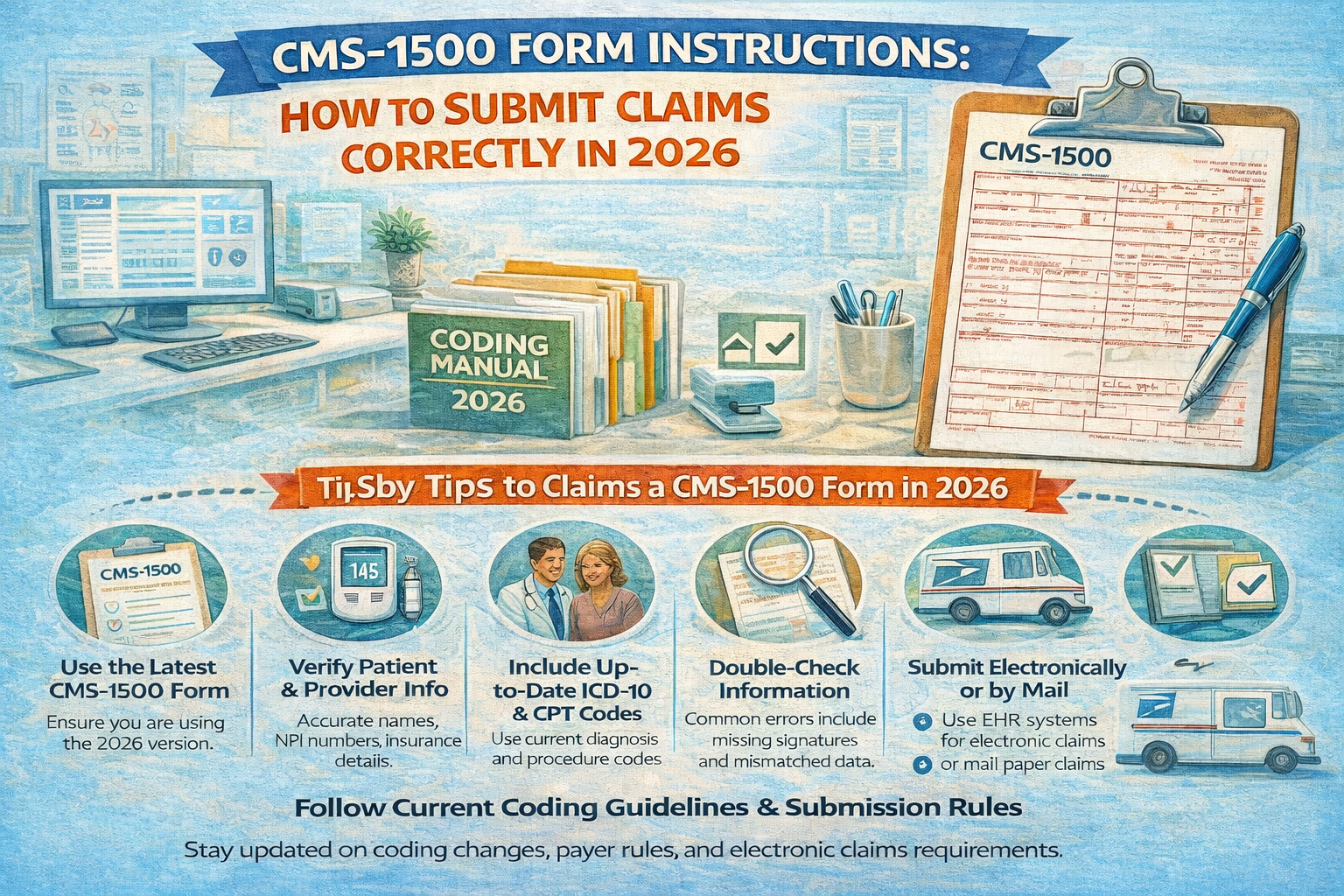
If you are working in the medical billing field, you must know the importance of the CMS-1500 form for the successful submission of claims.
The CMS-1500 claim form is the basic need of professional medical billing services, even with EHR linkages, clearinghouses, and automated billing technologies in 2026.
Whether you’re a solo provider, a growing clinic, or a multi-specialty practice, knowing how to properly complete and submit this form is important for timely reimbursement and to save your practice from frustrating claim denials.
Now that we’re in 2026, payers are even stricter about clean claim submissions. Electronic claim scrubbing is now smarter. Denials are more automated. And compliance expectations are higher. That means if your CMS-1500 form isn’t filled out correctly the first time, you’ll surely face delays. In this situation, what can you do to make your claims error-free?
Let’s discuss how to properly complete the CMS-1500 form in 2026.
What Is the CMS-1500 Form?
The CMS-1500 form or the HCFA 1500 form is the standard claim form used by healthcare providers to bill Medicare, Medicaid, and commercial insurance companies for professional services. The Centers for Medicare & Medicaid Services (CMS) is responsible for maintaining what is formally called the Health Insurance Claim Form. In 2026, the 02/12 revision is used which supports ICD-10 coding. Why is the CMS-1500 form used?
Providers use this form to inform insurance companies:
- The patient’s identity
- Which services were rendered?
- Why were those services medically necessary
- How much needs to be paid
Your claim can be rejected if even one of the sections is inaccurate, incomplete, or inconsistent.
Why Accuracy Matters More Than Ever in 2026
As the systems get more digitized, insurance companies are tightening their claim review processes. In 2026, payers are using:
- Advanced AI-based claim scrubbing
- Automated denial systems
- Real-time eligibility verification
- Pre-payment audits
That means each claim is strictly reviewed.
Submitting a clean CMS-1500 claim on the first attempt is critical for:
- Faster reimbursement
- Reduced denial rates
- Improved revenue cycle management
- Compliance with CMS guidelines
- Better cash flow for your practice
As an experienced medical billing company, Revantage Billing sees it time and time again and understands that small errors cause major delays.
Who Uses the CMS-1500 Form?
The CMS-1500 form is used by providers who bill for professional services, including:
If you’re billing for:
- Physician services
- Outpatient services
- Mental health services
- Therapy sessions
- Chiropractic care
- Urgent care visits
- Telehealth services
And specialty services like cardiology, dermatology, OB/GYN, etc., this form plays a central role in how you get paid. If your practice bills for outpatient professional services, then you’re submitting CMS-1500 claims either electronically or on paper.
Paper vs. Electronic CMS-1500 in 2026
Most claims in 2026 are submitted electronically via clearinghouses. But are they both the same? Electronic claims follow the same structure as the CMS-1500 form.
So whether you’re submitting through:
- An EHR
- A billing software platform
- A clearinghouse
- Or manually on paper
You still need to understand each field on the CMS-1500.
And yes, paper forms must still meet strict formatting guidelines:
- Red ink required (OCR-readable)
- No photocopies
- Proper alignment
- Typed or computer-generated entries
Step-by-Step CMS-1500 Claim Form Instructions for 2026
Let’s in detail each box of CMS-1500 claim form instructions so you never face any confusion.
Section 1: Patient and Insurance Information (Boxes 1–13)
This section is first and most important. Because if anything is wrong here, the claim won’t even make it past the first edit.
Box 1 – Insurance Type
Check the correct insurance type:
- Medicare
- Medicaid
- TRICARE
- CHAMPVA
- Group Health Plan
- FECA
- Other
Make sure it matches the patient’s actual coverage. But most of the time, mismatches happen here.
Box 1a – Insured’s ID Number
Enter the patient’s insurance ID, the same as it appears on their card. You make sure:
- No guessing.
- No characters are missing.
- No numbers were switched.
Even a small typo here can trigger an automatic rejection.
Boxes 2–7 – Patient Demographics
These include:
- Patient’s full legal name
- Date of birth
- Sex
- Address
- Relationship to insured
In 2026, always verify this information at every visit. Insurance data changes more often than patients realize.
Box 9 – Other Insured Information
If the patient has secondary insurance, this section must be completed accurately.
Coordination of benefits errors are one of the top causes of claim denials.
Box 11 – Insured’s Policy Information
This includes:
- Group number
- Employer information
- Insurance plan name
Incorrect group numbers are a silent revenue killer. So always double-check.
Box 12 & 13 – Patient Authorization and Assignment
These confirm:
- The patient authorizes the release of information
- The patient authorizes payment to the provider
In electronic claims, this is stored in the system but it must still be documented.
Section 2: Provider Information (Boxes 14–33)
In this section, many billing teams can even be stuck.
Box 14 – Date of Current Illness or Injury
Use the correct onset date.
For chronic conditions, follow payer-specific rules. Some insurers require the original onset date and others require the current episode date.
Box 17 – Referring Provider
If applicable, include:
- Referring to the provider’s name
- NPI (Box 17b)
If you miss any referring provider NPI here then you must expect a denial.
Box 21 – Diagnosis Codes (ICD-10-CM)
This is critical.
You can report up to 12 diagnosis codes.
Important 2026 reminder:
- Use the highest level of specificity.
- Don’t use unspecified codes unless absolutely necessary.
- Ensure diagnosis supports medical necessity.
Incorrect ICD-10 coding is one of the top reasons for claim denials.
It is simple to have claims denied right away by using out-of-date or removed ICD-10 codes. Additionally, keep in mind that the codes mentioned here must accurately match the diagnosis pointers used later in the service lines. Inaccurate diagnosis pointers are still a surprisingly frequent billing issue that can lead to denials of medical necessity.
Box 24 – Service Line Details
This section deserves extra attention.
For each service:
- 24A: Date of service
- 24B: Place of service (POS code)
- 24D: CPT/HCPCS code + modifier
- 24E: Diagnosis pointer
- 24F: Charge amount
- 24G: Units
- 24J: Rendering provider NPI
In 2026, place of service coding has become especially important due to ongoing telehealth billing adjustments. Using the wrong place of service code or forgetting required telehealth modifiers can cause immediate denials.
Modifiers must be applied to indicate special circumstances, such as 59 for distinct procedural services, 25 for separately identifiable E/M, or 95 for telehealth services. Make sure you’re using the correct POS code, like POS 11 for office, POS 22 for outpatient hospital, and POS 02 or 10 for telehealth (2026 telehealth updates apply), and modifiers based on current CMS guidance.
Box 25 – Federal Tax ID
Enter your EIN or SSN as registered with the payer.
Mismatch here can freeze payments.
Box 31 – Provider Signature
On paper claims, this must be signed.
On electronic submissions, signature is implied but documentation must exist.
Box 32 – Service Facility Location
If services were performed somewhere other than the billing provider’s address, list it here.
Include:
- Facility name
- Address
- NPI (if required)
Box 33 – Billing Provider Info
This must match what’s on file with the payer.
Include:
- Legal business name
- Address
- NPI
- Taxonomy (if required)
In 2026, a growing number of rejections will be due to NPI and taxonomy mismatches.
To prevent needless rejections, make sure your enrollment information and the claims you submit match.
Common CMS-1500 Errors That Cause Denials in 2026
Denials happen but most denials are preventable. Some of the biggest mistakes we see:
- Invalid ICD-10 codes
- Missing modifiers
- Incorrect diagnosis pointers
- Wrong NPI numbers
- Eligibility not verified
- Expired insurance coverage
- Incorrect place of service
- Duplicate claims
- Inconsistent provider information
If you fix these, your clean claim rate improves automatically.
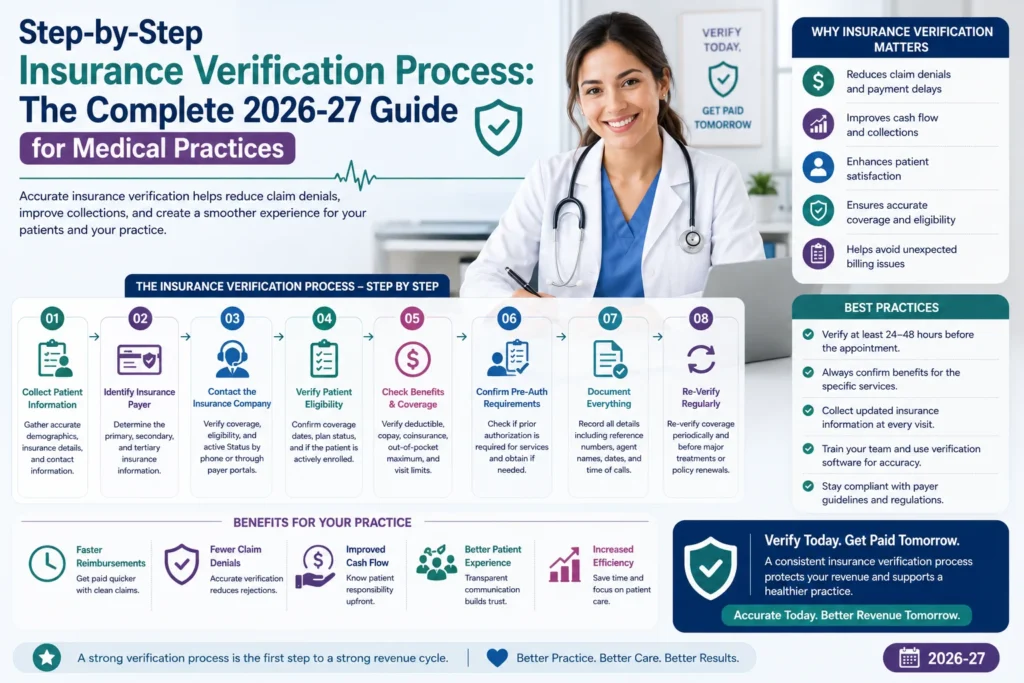
A large number of these mistakes are completely preventable. Before each appointment, insurance eligibility should be checked. This should include verification of active coverage, copay amounts, deductible status, referral requirements, and prior authorization needs. Ignoring eligibility verification is one of the quickest ways to raise rejection rates.
Why the CMS-1500 Paper Form Remains Essential in 2026
In 2026, we see that most claims are submitted electronically using the 837P format.
But why do you still need to understand the paper form? Let’s see:
- Some smaller payers still require a paper claims
- Appeals can require paper submission
- Correct data mapping depends on the CMS-1500 structure
- Training new billing staff starts with this form
Electronic claims must still follow CMS-1500 formatting standards.
Best Practices for Submitting CMS-1500 Claims Correctly
Now let’s talk about strategy. We always prefer the CMS-1500 guidelines.
Verify Insurance Before Every Visit
Eligibility verification should include:
- Active coverage
- Copay amount
- Deductible status
- Referral requirements
- Prior authorization
Use Updated ICD-10 and CPT Codes
Every year, code is updated.
In 2026, using out-of-date codes ensures rejections.
Check NPI and Taxonomy Alignment
Information about rendering and billing providers must match payer records.
Even little differences cause system rejections.
Scrub Claims Before Submission
Use claim scrubbing tools to:
- Detect missing fields
- Identify invalid codes
- Catch modifier errors
- Validate diagnosis pointers
Prevention is cheaper than rework.
Track Rejections and Denials
Monitor:
- First-pass acceptance rate
- Denial rate
- Rejection trends
- Payer-specific patterns
Data tells you where the leaks are.
2026 CMS-1500 Updates & Compliance Requirements
Stricter telehealth paperwork is the main emphasis of 2026 compliance, even though the 02/12 form version is still the standard.
- An increase in payer audits
- Verification of eligibility in real time
- Verification of NPIs
- Enforcement of ICD-10 specificity
- Accuracy of electronic claim formatting
Nowadays, a lot of claims are rejected by clearinghouses before they even get to the payer.
How Revantage Billing Helps You Get It Right
Filling out the CMS-1500 form isn’t complicated but doing it perfectly, consistently, and compliantly matters. Unfortunately, more of the practices struggle here. With years of experience in submitting claims, Reventage Billing understands all the CMS-1500 guidelines. We help healthcare providers to reduce claim denials, improve clean claim rates, increase reimbursement speed, ensure CMS compliance, and optimize revenue cycle management. Because reactive billing is no longer sufficient in 2026. Proactive revenue management is necessary.