
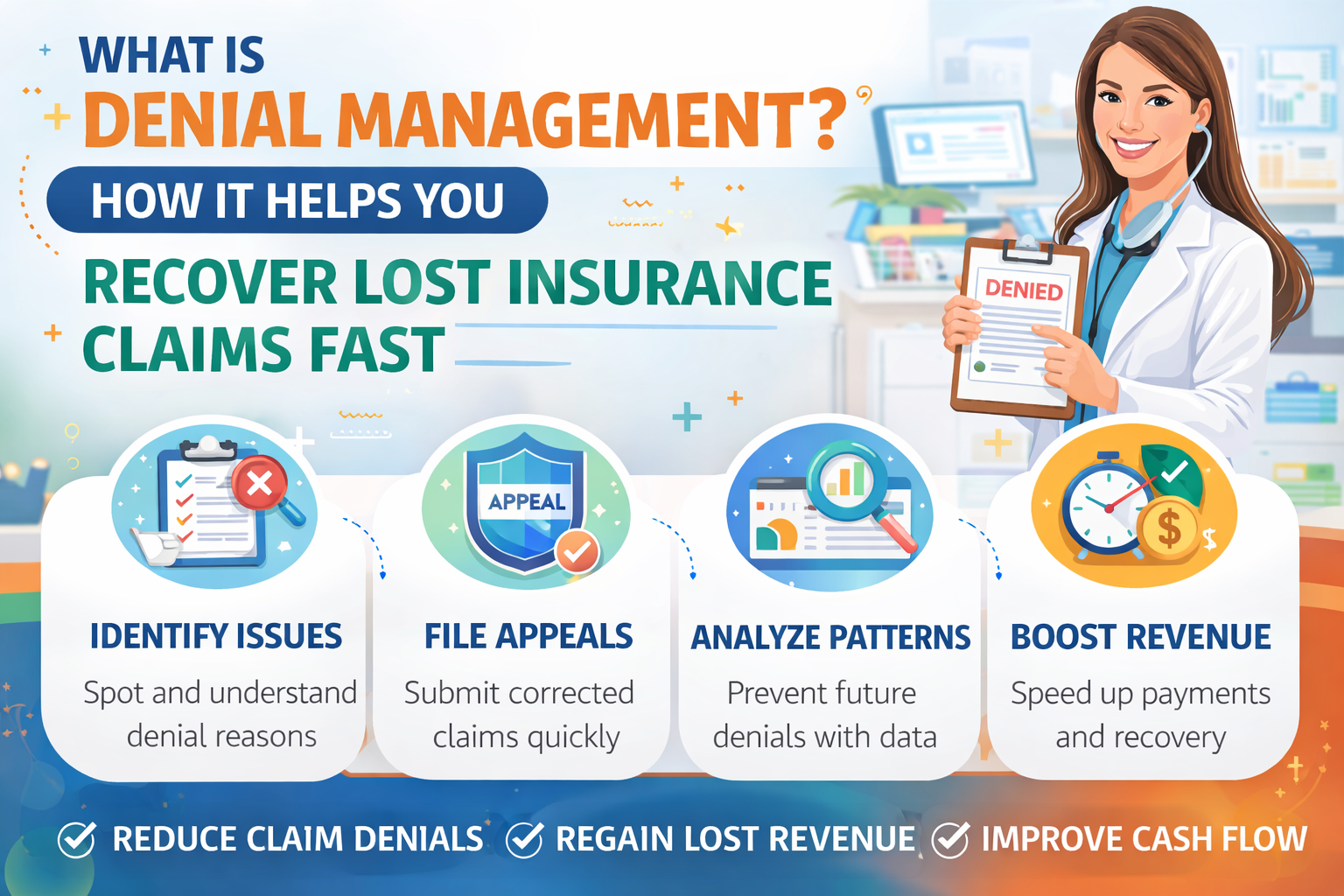
Medical billing requires the successful submission of claims, and when these claims contain any errors or do not fulfill the required requirements, then the claims get denied. Even when you do everything right and submit a claim, you still see a denial. And this process is sometimes very frustrating and more costly.
Now, how to handle this situation?
The solution is only denial management. But denial management services are not just about fixing rejected claims. It’s about building a smarter and more efficient billing process that prevents revenue loss before it even starts. When you do it right, it can speed up reimbursements, improve cash flow, and reduce administrative headaches. It shows that efficient denial management helps to smooth each medical billing process.
No matter if you have a small practice or a large healthcare organization, denial management is a necessity for your billing operations.
So let’s discuss how denial management services work and how they can help you recover lost insurance claims fast.
What Is Denial Management?
Denial management in medical billing is the process of identifying, analyzing, correcting, and preventing denied insurance claims.
When an insurance company refuses to pay a claim either partially or fully, that’s considered a denial. After this denial happens, practices need proper denial management to recover the losses. In this process:
- You figure out why the claim was denied
- You fix the issue
- You resubmit the claim
- And ideally, you get paid
But it doesn’t stop there.
A strong denial management strategy also looks at patterns. If the same types of denials keep popping up, then it means that something is wrong; it can be coding errors, missing documentation, or eligibility issues. Finding and fixing root causes is needed and called proactive revenue cycle management.
Why Denial Management Matters More Than Ever
If you say denials are very rare in medical billing, then you are wrong. In fact, denials are now becoming more common across the healthcare industry.
Insurance companies have very strict rules, and even a small mistake here can cause rejections. Without a solid denial management process, those denied claims can increase quickly. Let’s see the outcomes each practice faces without efficient denial management.
Lost Revenue Adds Up Fast
Every denied claim represents money you’ve already earned but haven’t received. If those claims aren’t followed up on, that revenue is essentially lost.
Cash Flow Takes a Hit
Delayed payments mean slower cash flow. And for many practices, that can impact payroll, operations, and growth.
Administrative Burden Increases
Chasing down denied claims takes time. Without a streamlined system, your staff can get overwhelmed quickly.
Higher Write-Off Rates
The longer a denial sits unresolved, the less likely it is to be paid. Over time, unresolved denials often turn into write-offs, which directly impact profitability.
That’s why denial management in medical billing isn’t optional; it’s essential for all the practices.
Types of Claim Denials You Should Know
Not all denials are the same. And understanding the type of denial helps you decide how to handle it.
Soft Denials
Those denials are called soft denials that are temporary and usually fixable. These often result from minor issues, including:
- Missing information
- Minor coding errors
- Documentation issues
But the good thing is that these denials can be corrected and resubmitted quickly.
Hard Denials
As the name shows, these denials are more serious and most of the time irreversible. They occur when:
- Services not covered
- Expired filing deadlines
- Lack of medical necessity
Hard denials are also known as permanent denials, which means that they are tougher to recover, which is why prevention is key.
Common Reasons Insurance Claims Get Denied
Before you can fix denied claims effectively, you need to understand what’s actually causing them in the first place. Most denials don’t happen randomly; they’re usually small but critical errors somewhere in the billing process. But once you identify these common issues, you can start preventing them.
Incorrect Patient Information
One of the most basic and surprisingly common reasons for claim denials is incorrect patient information. This could be something as simple as a misspelled name, the wrong date of birth, or an outdated insurance ID number. When this small mismatch happens between a claim and a file in the insurance company, it triggers an automatic denial. For us, it’s very minor but these errors can completely disturb the whole payment process until they are corrected and submitted.
Eligibility Issues
Eligibility problems are another major cause of denials. If a patient’s insurance coverage isn’t active at the time of service, or if the specific treatment isn’t covered under their plan, then the claim will likely be rejected. This often happens when eligibility isn’t verified before the appointment. Sometimes, patients do not even realize their coverage has changed, which makes front-end verification even more important.
Coding Errors
Medical coding plays a huge role in whether a claim gets approved or denied. Using the wrong CPT or ICD-10 codes, mismatching diagnosis and procedure codes, or failing to include necessary modifiers can all lead to denials. Coding errors are also dangerous for insurers, causing delays or additional investigation. As coding rules change frequently that’s why even experienced staff can make mistakes without regular training and updates.
Missing Documentation
Medical coding plays a huge role in whether a claim gets approved or denied. Using the wrong CPT or ICD-10 codes, mismatching diagnosis and procedure codes, or failing to include necessary modifiers can all lead to denials. Coding errors are also dangerous for insurers, causing delays or additional investigation. As coding rules change frequently, that’s why even experienced staff can make mistakes without regular training and updates.
Duplicate Claims
A claim can be rejected if it is submitted more than once without the right indication. This typically occurs when there is a payment delay and employees believe the claim was not handled. The claim is resubmitted, and the insurers view it as a duplicate rather than verifying its status. Never assume that a mistake is harmless because it can lead to needless delays and issues.
Authorization Problems
Certain procedures and services require prior authorization from the insurance company. If that authorization isn’t obtained before the service is performed, the claim will almost always be denied. In some cases, retroactive authorization is also possible, but it’s not guaranteed. And due to missing this step, many practices face great revenue loss, especially for high-cost procedures.
Timely Filing Issues
Every insurance provider has strict deadlines for filing claims. A claim will be rejected if it is submitted after that date, even if all other details are accurate. Timely filing denials are particularly frustrating because they’re often non-reversible. This is why it’s crucial to have a system in place for correctly submitting claims.
Key Metrics to Track in Denial Management
If you are looking to improve your denial management strategy, then you need to monitor the correct numbers. These numbers provide a clear description of the performance of your billing system.
Denial Rate
This calculates the percentage of claims that insurers reject. A high denial rate indicates that there are current problems with your billing procedure that need to be fixed.
First Pass Resolution Rate (FPRR)
This measure displays the number of claims that are accepted upon initial submission. A higher percentage indicates that your claims are accurate and complete from the start.
Days in Accounts Receivable (A/R)
This keeps track of how long it takes to get paid after filing a claim. A more effective revenue cycle is indicated by shorter A/R days.
Appeal Success Rate
This shows how effective your team is at recovering denied claims. A higher success rate means your insurance claim denial management process is working well.
Write-Off Rate
This measures the percentage of claims that are never recovered. Keeping this number low is essential for maintaining profitability.
The Denial Management Process
Identify the Denial
The first step is to accept that a claim has been rejected. Usually, this information is obtained through:
- Benefits Explanation (EOBs)
- Advice on Electronic Remittances (ERAs)
These reports give specifics on the reasons the claim was rejected as well as the issues that need to be resolved. Keep in mind that timing is critical in this situation. When you quickly identify the denial, you can address it quickly and increase your chances of recovery.
Categorize the Denial
Once the denial is identified, the next step is to categorize it based on the reason. And the reason can be coding errors, eligibility issues, authorization problems, or documentation gaps. Arranging denials into categories makes the process easier by enabling your staff to deal with related problems in groups. Additionally, it also facilitates the identification of persistent issues that require long-term solutions.
Analyze the Root Cause
This is where many practices overlook an important opportunity. It is very crucial to go deeper and understand why the denial occurred in the first place rather than just fixing the mistake or recovering one claim.
Was there insufficient training?
An issue in the system?
Poor communication between departments?
Finding the root cause saves time and effort in the future by preventing the same problem from occurring again.
Correct and Resubmit the Claim
After identifying the issue, it’s time to fix it. To fix denials accurately update patient information, correct coding errors, attach missing documentation, or obtain retroactive authorization if possible. Once you make all the corrections, your claims should be resubmitted accurately. The quicker this step is completed, the faster the reimbursement process can resume.
Track and Follow Up
Many people have this misconception that resubmitting a claim guarantees payment. It’s not necessary, which is why follow-up is so important. Practices need to actively monitor the status of resubmitted claims, check for updates, and communicate with insurance companies when necessary. If there are delays or additional issues, timely follow-up can help resolve them before they turn into long-term problems.
Prevent Future Denials
Prevention is the last and most important step. Always prefer prevention before considering a claim denial. Practices can improve their billing processes by analyzing denial trends and patterns. This can involve improving workflows, adding more staff training, or implementing more effective verification mechanisms. All these steps help to reduce the rejection rate and make your revenue cycle more effective.
Best Practices for Effective Denial Management
Let’s talk about strategy.
Verify Insurance Before Every Visit
Don’t assume that coverage is active. It is easier to identify eligibility problems early when insurance is verified before each patient visit. So, make sure to double-check.
Invest in Staff Training
Rules for coding evolve. Policies for insurance change. When you invest in staff training, it helps to ensure that your team is up to date on these code changes and insurance requirements.
Use Technology to Your Advantage
Automation technologies and billing software can help you identify mistakes before claims are filed or submitted. This lowers the possibility of rejection.
Standardize Your Workflow
Create effective and clear processes for managing denials. The secret is to be consistent.
Prioritize High-Value Claims
High-value claims are first needed to address so focus on the most important reimbursements first.
Maintain Clear Documentation
Finally, keeping correct and clear documentation is essential as it validates your claims and gives insurance the proof they require.
Why Outsourcing Denial Management to Revantage Billing Helps You Stay Ahead
Handling insurance claim denial management in-house is not an easy task. It becomes difficult for staff to manage when your practice grows and the volume of claims increases. That’s why many healthcare providers choose to outsource denial management services to experienced denial management companies like Revantage Billing.
- Our experienced professionals work to prevent denials from occurring in the first place rather than just correcting them.
- To safeguard patient data and guarantee compliance, our billing and coding procedures comply with strict rules.
- Over time, Revantage Billing helps you enhance your billing performance by examining trends and patterns.
The most crucial aspect is that Revantage Billing uses data-driven strategies to consistently enhance your billing results. We assist you in making more informed choices that improve productivity and lower the number of denials in the future by monitoring trends and performance indicators. Our goal is not just to recover claims, but also to increase your revenue while minimizing stress.