If you are already in the healthcare field or starting a new practice, you must be confused about how to manage the billing of your patients. Medical billing is not just about sending claims and getting paid. It’s a complete process that requires a constant balancing act of coding accuracy, payer rules, denial management, compliance updates, and chasing reimbursements. And it’s not easy to manage. That’s why more healthcare providers across the U.S. are outsourcing their billing.
Now you must think:
How much do medical billing services actually cost in 2026?
You can’t get the answer in a single word because pricing varies depending on your specialty, practice size, claim volume, and the level of service you need. So let’s give me a detailed estimate of cost and see what you’re paying for and how to choose the right billing partner.
Why Medical Billing Costs Matter?
Healthcare has changed a lot over the past few years. Payer rules are stricter, audits are more frequent, and reimbursement timelines are longer. Additionally, staffing shortages have made it more difficult for practices to maintain in-house billing teams.
So now, the real question isn’t just How much does billing cost?
It’s also necessary to think, How much is poor billing costing you?
Poor billing means:
- Denied claims and lost revenue
- Slow reimbursements and cash flow issues
- Coding errors that cause compliance risks
- Staff burnout ultimately leads to turnover and training costs
When you look at it this way, then you better understand that investing in professional medical billing services is a revenue strategy.
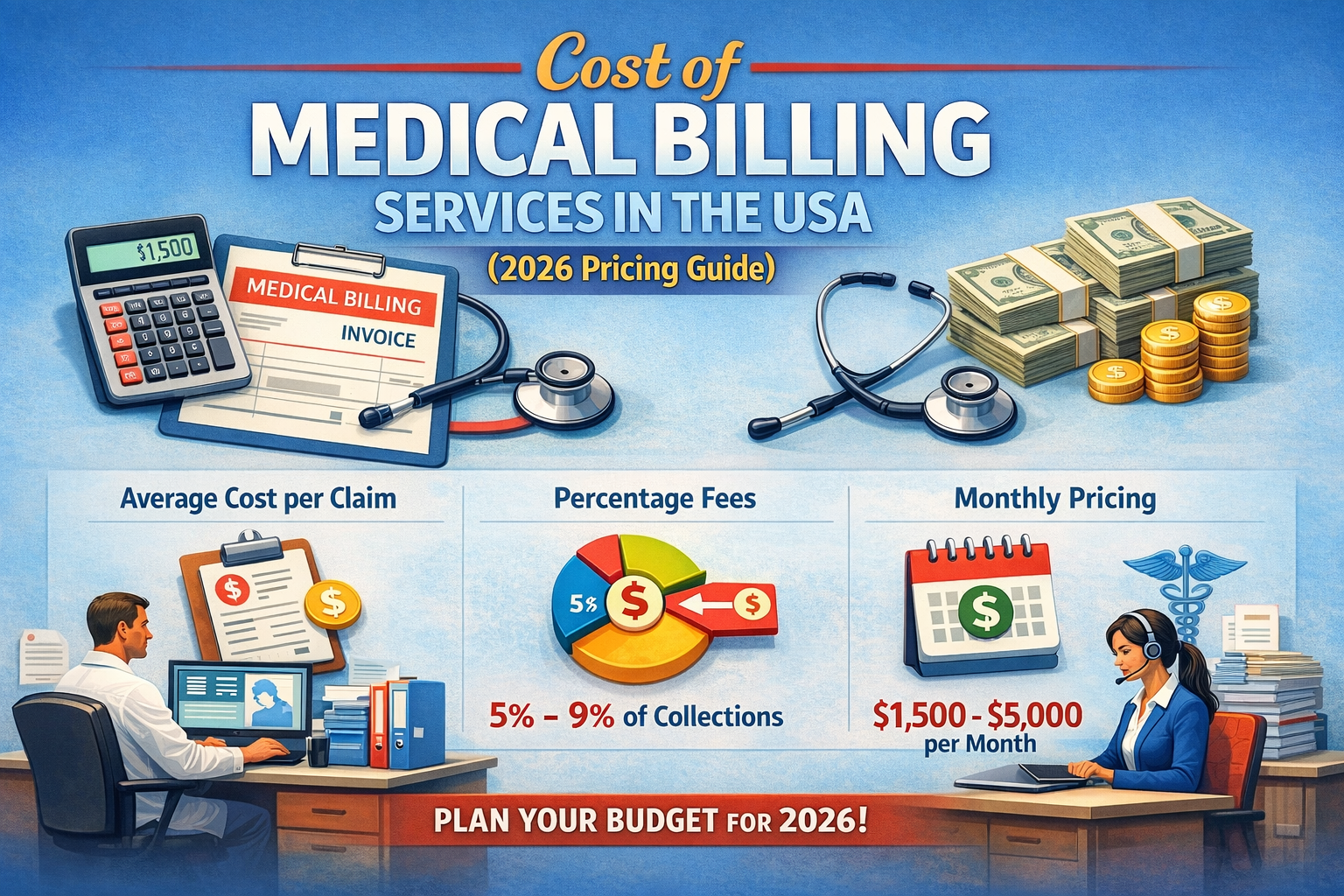
Average Cost of Medical Billing Services in the USA
In 2026, most medical billing companies in the U.S. charge using one of these common pricing models:
Percentage-Based Pricing (Most Common)
- Typical Range: 4% to 9% of collections
- Best For: Small to mid-sized practices and for growing clinics
This is the most popular pricing model. The billing company takes a percentage of what they successfully collect for your practice.
Example:
If your practice collects $100,000 in a month and your billing rate is 6% then you’ll pay $6,000.
Why providers like it:
- No upfront cost
- Billing company is motivated to collect more
- Scales with your revenue
Flat Fee Per Claim
- Typical Range: $3 to $10 per claim
- Best For: High-volume practices with simple billing needs
You just pay a fixed amount for each claim submitted instead of a percentage.
Example:
1,000 claims × $5 = $5,000/month
This model doesn’t always include denial management, AR follow-ups, or reporting so you need additional services to manage these tasks.
Hourly Pricing
- Typical Range: $25 to $65 per hour
- Best For: Short-term projects or consulting
This is less common for full-service billing but is used for:
- Cleanup of old accounts receivable
- Coding audits
- Staff training
Hybrid Pricing Models
Some billing companies combine models. For example:
- Lower percentage like 4% + small monthly fee
- Per-claim fee + AR follow-up charges
This option is no doubt a flexible choice for you but sometimes it can be confusing if you’re not careful.
What Influences Medical Billing Costs?
Remember that each practice has its own scenario, so not every practice pays the same rate. Let’s see some factors that directly impact your billing costs.
Your Medical Specialty
Not only practices but also specialties differ in terms of billing complexity.
Lower-cost specialties:
- Primary care
- Family medicine
- Internal medicine
Higher-cost specialties:
- Cardiology
- Orthopedics
- Pain management
- Psychiatry
- Dermatology (due to procedure coding)
The more complex your coding and documentation requirements, the higher the billing cost.
Practice Size and Claim Volume
Larger practices with higher claim volumes often get lower rates.
You may be surprised here and ask first Why? Because billing companies benefit from economies of scale.
- Small practice: 7%–9%
- Mid-size practice: 5%–7%
- Large practice: 4%–6%
Scope of Services
Medical billing is not just the name of a single service; instead, a number of services are included in it and not all of these services are full-service. Some companies only handle claim submission. Others offer end-to-end revenue cycle management.
Basic services include:
- Charge entry
- Claim submission
Full-service billing includes:
- Insurance verification billing services
- Coding support services
- Denial management services
- AR follow-ups
- Payment posting
- Reporting and analytics
So you understand that more services mean higher cost and also higher revenue potential.
Practice Software & EHR Integration
Medical billing companies also utilize the latest medical billing software and if you already have a practice, then the outsourced billing company first needs to integrate with your existing Electronic Health Record (EHR) system, which can affect pricing.
Some companies charge:
- Setup fees ($500–$2,000)
- Monthly software usage fees
Others include it in their pricing.
Claim Complexity & Clean Claim Rate
If your practice has a high denial rate or poor documentation, billing companies can charge more to compensate for the extra work.
On the flip side, a clean and efficient practice can qualify for lower rates.
Hidden Costs You Should Watch Out For
With this cost, there is also something that most providers overlook.
Remember that not all billing companies are transparent with their pricing. Some advertise low rates but then add extra charges later.
That’s why you need to watch out for:
- Setup fees (one-time onboarding cost)
- Credentialing fees
- Patient billing fees
- Reporting fees
- Denial management charges
- Clearinghouse fees
Always ask for a full list of costs upfront.
In-House Billing vs Outsourcing: Cost Comparison
When you start a practice then you must also see the in-house billing costs and decide on one. So let’s make this decision easy for you and compare the real cost of doing billing in-house vs outsourcing.
In-House Billing Costs
- Salaries: $40,000–$70,000 per billing staff member
- Training and certifications
- Software and licensing
- Employee benefits
- Office space and equipment
Total annual cost: $60,000–$120,000+ per employee
Outsourced Billing Costs
- Typically 4%–9% of collections
- No employee overhead
- No training costs
- Access to a full team of experts
In most cases, outsourcing is not only more efficient but actually more cost-effective.
How Much Can You Save or Earn More?
Now this is very important to understand. The best medical billing company doesn’t just reduce your workload but also helps you to increase your revenue.
Many practices report:
- 15%–25% increase in collections
- 30%–50% reduction in denials
- Faster payment cycles
So even if you’re paying 6%, your net revenue often increases significantly.
What You Should Expect at Different Price Points
Now give you a rough estimate of what you need to expect when you start a partnership with a medical billing company:
Low-Cost Billing (4%–5%)
- Basic claim submission
- Limited AR follow-up
- Minimal reporting
- Less personalized support
Mid-Range Billing (5%–7%)
- Full revenue cycle management
- Denial handling
- Regular reporting
- Dedicated account manager
Premium Billing (7%–9%)
- Specialty-specific expertise
- Advanced analytics
- Compliance support
- Aggressive AR recovery
- Custom workflows
Red Flags When Evaluating Billing Companies
As there are a lot of medical billing companies in the US and each company says it is the best one, it becomes very difficult for you to decide and trust one. So here are some warning signs you should notice before you sign any contract:
- No clear pricing structure
- Long-term contracts with no exit clause
- Poor communication or delayed responses
- Lack of transparency in reporting
- No experience in your specialty
A good billing partner should feel like your business member, not just a vendor.
How to Choose the Right Medical Billing Company
Picking the right billing company isn’t just about cost; it’s about value. So whenever you choose a medical billing company, consider:
Industry Experience
Make sure they understand your specialty inside and out.
Transparency
Clear pricing, detailed reports, no hidden fees.
Technology
Modern billing software, real-time dashboards, EHR integration.
Communication
You should never feel left in the dark about your revenue.
Proven Results
Ask for performance metrics—collection rate, denial rate, turnaround time.
Why Revantage Billing Is a Smart Investment in 2026
At the end of the day, you don’t just need a billing company, you need a revenue partner. And if you want actually the best in the US, there’s no better choice than Revantage Billing.
Our team of experts focuses on:
- Customized billing strategies according to your practice
- End-to-end revenue cycle management
- Aggressive denial follow-ups and AR recovery
- Transparent pricing with no surprises
- A dedicated support team that actually communicates
Real Results You Can Expect
Revantage Billing doesn’t just promise results, we deliver measurable outcomes:
- Up to 20% increase in collections
- Claims processed with a 95%+ accuracy rate
- Denials reduced by 30% or more
- Faster reimbursements and improved cash flow
So without wasting your time on testing other billing companies, just reach out to the best medical billing company, Revantage Billing. Just contact us today and book your slot.