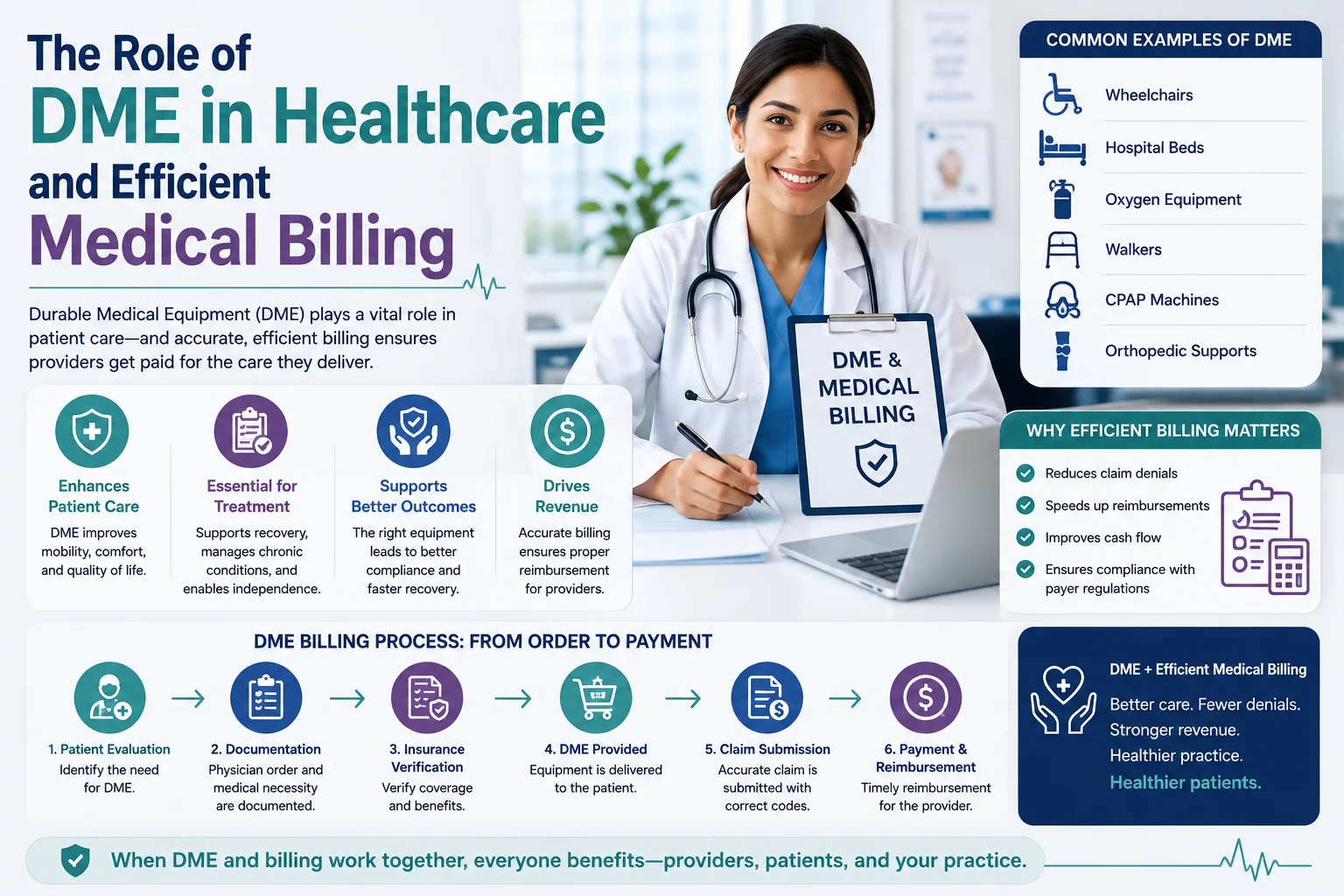
Durable Medical Equipment (DME) is an important part of healthcare because it helps patients manage their conditions at home. To manage these conditions, some items like wheelchairs, CPAP machines, and oxygen equipment are required that can improve daily life and even reduce hospital visits. But billing for DME is more complex than standard medical billing. Even a small mistake like a missing modifier, incomplete documentation, or an incorrect order can lead to claim denials, payment delays, or audits.
That’s why understanding DME billing is essential for healthcare providers, DME suppliers, and medical billing companies to protect revenue and ensure faster reimbursements. So let’s discuss what DME is and why it matters in revenue cycle management (RCM).
What Is Durable Medical Equipment (DME)?
Durable Medical Equipment (DME) includes medical devices and equipment that a doctor prescribes for patients to use at home. To qualify as DME under Medicare Part B, the equipment must be durable, used just for a medical purpose, intended for home use, and generally not useful to someone who is not sick or injured.
Some common types of DME include:
- Mobility equipment: Wheelchairs, walkers, canes, and mobility scooters
- Respiratory equipment: Oxygen concentrators, CPAP and BiPAP machines, nebulizers, and ventilators
- Hospital beds and support equipment: Hospital beds, pressure-relieving mattresses, and patient lifts
- Diabetes management devices: Continuous glucose monitors (CGMs) and insulin pumps
- Prosthetics, orthotics, and medical supplies: Artificial limbs, braces, ostomy supplies, and urological supplies
These products are collectively called DMEPOS (Durable Medical Equipment, Prosthetics, Orthotics, and Supplies), the category that Medicare regulates.
Unlike regular medical supplies used during a clinic visit, DME follows a different billing process. DME billing is more complex than standard medical billing because claims often require extensive medical documentation, proof of medical necessity, and can be rental or recurring billing.
Why DME Billing Plays a Central Role in Revenue Cycle Management
DME billing is more complicated as compared to standard medical billing because it follows different rules, documentation requirements, and reimbursement processes. It needs attention for different reasons:
It is not paid to the standard Medicare Administrative Contractor (MAC). Unlike regular medical claims, DME claims are processed by DME Medicare Administrative Contractors (DME MACs) instead of standard Medicare Administrative Contractors (MACs). If you submit a claim to the wrong contractor it can cause an automatic rejection before the claim is even reviewed for medical necessity.
It runs on recurring billing cycles, not one-time charges. Many DME items like oxygen equipment and hospital beds are billed as monthly rentals rather than one-time purchases. This means providers need to submit 13+ consecutive monthly claims that make accurate documentation and ongoing eligibility essential for continuous reimbursement.
Reimbursement is document-driven, not just code-driven. Just making HCPCS coding accurate alone is not enough. Most DME claims also require supporting documents, including:
- A Standard Written Order (SWO)
- Proof of medical necessity
- A face-to-face visit note (when required)
- Proof of Delivery (POD)
If you miss any of these documents your claims can be denied even if the coding is correct.
It is one of the most heavily audited corners of Medicare. DME is a frequent target of Additional Documentation Requests (ADRs), Targeted Probe and Educate (TPE) reviews, and Comprehensive Error Rate Testing (CERT) audits. So it is closely monitored by Medicare because of its history of improper payments. High-cost claims for items such as wheelchairs, respiratory equipment, diabetes supplies, and other high-cost medical equipment are frequently reviewed through audits and documentation requests.
Why It Matters
DME billing is a specialized area of medical billing that requires careful attention to coding, documentation, and payer guidelines. Providers and suppliers that follow DME billing requirements accurately are more likely to reduce denials, improve cash flow, and receive timely reimbursements.
The Core Components of Accurate DME Billing
HCPCS Level II Coding
We all understand medical procedures are billed using CPT codes but Durable Medical Equipment (DME) is billed using HCPCS Level II codes. Common categories of codes include:
- E-series: Medical equipment such as CPAP machines (E0601) and oxygen concentrators (E1390)
- K-series: Mobility equipment including power wheelchairs
- A-series: Medical supplies
- L-series: Prosthetics and orthotics
CMS updates this code set every quarter, so billing teams should be aware of these changes as using outdated code lists regularly give you avoidable denials.
Common DME Billing Modifiers
Modifiers play an important role in DME billing because they tell the payer how the equipment is being provided and whether coverage requirements have been met.
- RR: Rental equipment
- NU: New equipment purchase
- UE: Used equipment purchase
- LT / RT: Left or right side of the body
- KX: Confirms that all coverage requirements and documentation are met
- GA: Advance Beneficiary Notice (ABN) is on file
- GZ: No ABN was obtained, and a denial is expected
- GY: Item is not covered by Medicare
Why the KX Modifier Matters
The KX modifier is one of the most important modifiers in DME billing. It confirms that the claim meets all Medicare coverage requirements and that the required documentation is available. If you apply the KX modifier without proper supporting records, it can cause claim denials, post-payment audits, or repayment demands. That’s why billing teams should only use the KX modifier when all documentation requirements have been fully satisfied.
The Standard Written Order (SWO)
Since 2023, Medicare has replaced the Certificate of Medical Necessity (CMN) and DME Information Form (DIF) with the Standard Written Order (SWO).
A valid SWO must include:
- Patient’s name
- Description of the item or HCPCS code
- Treating provider’s signature and date
- Quantity ordered
Incomplete orders, confused equipment descriptions, or missing signatures are common reasons for claim denials.
Medical Necessity and Face-to-Face Documentation
Many high-cost DME items like power wheelchairs require documentation that proves the equipment is medically necessary. In some cases, Medicare also requires a face-to-face visit before approving the claim.
The provider’s clinical notes should clearly explain why the patient needs the equipment and how it will help with daily activities. General statements without supporting details often result in denials.
Proof of Delivery (POD)
Suppliers must keep Proof of Delivery (POD) records showing that the equipment was delivered and accepted by the patient. These records include:
- Delivery date
- Delivery method
- Patient or authorized representative’s signature
Without POD, a claim can be denied or payments can be recovered during an audit.
Prior Authorization
Some high-cost DME items require prior authorization before they can be billed. This is especially common for power mobility devices and certain respiratory equipment.
Completing prior authorization requests completely and accurately can help avoid delays and improve the chances of getting your claim approved faster.
Rental vs. Purchase Billing
It’s not necessary that all DME be purchased outright. Equipment such as oxygen concentrators and hospital beds is often billed as a monthly rental for a specific period before ownership rules change.
Billing a purchase as a rental, or a rental as a purchase, can lead to claim denials, payment delays and compliance problems. That’s why understanding how each HCPCS code should be billed is important for correct reimbursement.
Recent CMS Updates Affecting DME Billing (2026–2028)
CMS has introduced several important changes to DME billing that providers and suppliers should prepare for over the next few years. Staying up to date with these changes can help reduce claim denials, maintain compliance, and avoid reimbursement delays.
The DMEPOS Competitive Bidding Program is being revived and expanded. CMS finalized the CY 2026 Home Health and DMEPOS Competitive Bidding Program (CBP) rule, published in the Federal Register on November 28, 2025. Beginning with the next bidding round, additional product categories will be included such as:
- Continuous Glucose Monitors (CGMs)
- Insulin pumps
- Urological supplies
- Ostomy supplies
- Hydrophilic urinary catheters
- Off-the-shelf (OTS) back, knee, and upper-extremity braces
All these items will be managed through a new nationwide delivery program.
The bid-setting methodology has changed. CMS has changed how winning bids are selected. Instead of using the previous pricing model, the new process uses the 75th percentile of winning bids and requires less financial documentation during the bidding process.
Accreditation just became an annual requirement. DMEPOS suppliers must now complete accreditation every year instead of every three years. This means a new administrative and compliance burden for every enrolled supplier so they need to pay closer attention to renewal deadlines and compliance requirements.
The rollout has a defined, multi-year timeline. CMS is introducing these changes in phases over several years. The process began with supplier awareness activities in late 2025, followed by bidder registration and the competitive bidding process in 2026. Contract awards and payment rates will be announced in 2027 and the new program is expected to take effect by January 1, 2028. After that, CMS will provide a six-month transition period to help beneficiaries adjust to the new system.
CGMs and insulin pumps are being reclassified. Continuous Glucose Monitors (CGMs) and insulin pumps will move to a monthly rental payment model. The monthly payment will include the device along with its related supplies and accessories, changing how these items are billed and reimbursed.
Not every proposed change made it through unopposed. Some healthcare organizations and patient advocacy groups have raised concerns about including ostomy, urological, and related supplies in the Competitive Bidding Program. But CMS finalized the rule, so providers and suppliers should prepare for these changes as planned.
What Providers and Billing Teams Should Do
To improve DME billing and reduce claim denials, providers and suppliers should:
- Keep complete and accurate documentation for every claim.
- Use a dedicated workflow for DME billing instead of treating it like standard medical billing.
- Track rental periods and recertification deadlines to avoid missed payments.
- Stay updated with HCPCS code changes and Medicare billing rules.
- Prepare for the 2026–2028 CMS DMEPOS updates and competitive bidding changes.
- Consider outsourcing DME billing to an experienced medical billing company if managing claims becomes difficult or denial rates increase.
How Revantage Billing Manages DME Revenue Cycle Management
At Revantage Billing, we have been serving DME specialized services for years. Our team understands the unique requirements of DME claims including DME MAC guidelines, LCD-based medical necessity documentation, HCPCS coding, modifier accuracy, rental billing, and prior authorization requirements.
Our team of experts stay up to date with the latest CMS regulations so providers and suppliers don’t have to worry about keeping track of every policy update. We are here to reduce denials, speed up reimbursements, and protect your revenue. So without wasting time, book a free coding audit today and see hidden revenue opportunities. Contact us today at billing@revantagebilling.com