
Each healthcare practice wants a consistent cash flow but this is not only possible with quality patient care. The main barrier that occurs in a healthy revenue cycle is claim denials.
Every denied claim represents delayed revenue, additional administrative work, and increased operational costs. According to industry estimates, healthcare providers lose billions of dollars annually due to denied and underpaid claims. But do you know that you can prevent these denials just by implementing proven revenue cycle management (RCM) best practices.
Healthcare practices can reduce claim denials by as much as 30% or more while improving cash flow, accelerating reimbursements, and increasing overall financial performance. So let’s show you the most effective revenue cycle strategies that help you to minimize denials, improve clean claim rates, and optimize reimbursement outcomes.
What Are Claim Denials in Healthcare?
Claim denials mean an insurance company refuses to pay a healthcare provider for services rendered. These claims are fully processed but not accepted for payment due to specific insurance policy conditions.
Unlike claim rejections, which occur before claim processing due to missing information or formatting errors, denials happen after the payer reviews the claim and determines that it does not meet payment requirements.
Denials can be classified as hard denials (non-recoverable) or soft denials (correctable and resubmittable). According to industry benchmarks, the average denial rate across U.S. healthcare practices is between 5% and 10% but top-performing practices consistently keep it under 3%.
Common Causes of Healthcare Claim Denials
- Incorrect patient information, including the wrong date of birth or member ID
- Eligibility verification errors mean services rendered to patients with lapsed or incorrect insurance
- Missing prior authorization that shows procedures performed without required pre-approval
- Coding mistakes due to outdated, incorrect, or unbundled CPT/ICD-10 codes
- Medical necessity concerns that show insufficient documentation to justify the service billed
- Duplicate claims, such as submitting the same claim more than once
- Timely filing violations mean claims submitted after the payer’s filing deadline
When denials become frequent, they create major financial challenges for medical practices.
The Financial Impact of Claim Denials
If you are thinking that having some healthcare claim denials does not impact your revenue then you are very wrong. Even a single denial can cost you because each denial requires staff time to find, correct, appeal, and resubmit it. The average cost to rework a single denied claim is $25–$118. This administrative burden increases operational expenses while reducing productivity.
And in the end, practices face consequences such as reduced cash flow, increased accounts receivable (A/R) days, higher billing costs, revenue leakage, staff burnout, and an increased risk of write-offs. Estimated 65% of denied claims are never resubmitted, which means a pure revenue loss.
That’s why denial management in healthcare becomes an important factor for all practices. Remember, reducing denials is not just about fixing billing errors; it directly impacts your practice’s profitability and cash flow.
8 Revenue Cycle Best Practices to Reduce Claim Denials
Verify Patient Eligibility Before Every Appointment
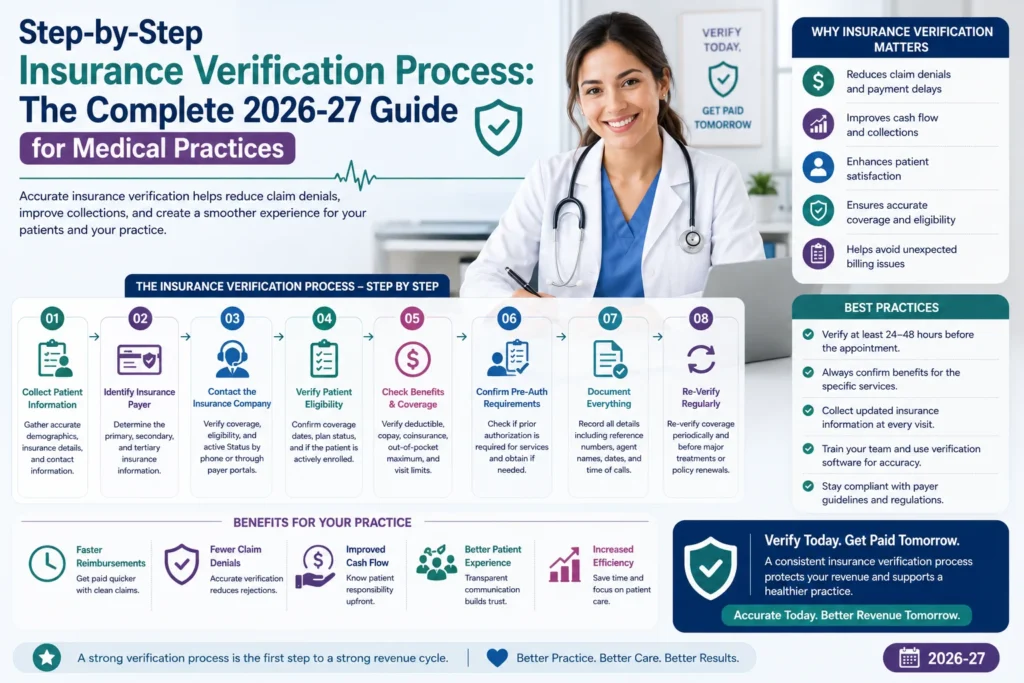
Eligibility errors mean using the wrong insurance on file, lapsed coverage, and the wrong plan type. But these causes of denial are easy to prevent. During the eligibility verification process, you should verify:
- Active coverage confirmation
- Policy validation
- Copayment verification
- Deductible status review
- Referral requirements
- Authorization requirements
Best practice: Run automated eligibility checks 72 hours before each scheduled appointment and again at check-in. Implement a real-time eligibility verification tool integrated directly with your practice management system.
Build a Prior Authorization Tracking System
Missed or expired prior authorizations continue to be one of the leading denial reasons, especially in specialties like radiology, orthopedics, and oncology.
A reliable authorization workflow should:
- Identify which CPT codes require authorization by the payer
- Initiate authorization requests 5–7 business days before the procedure
- Log authorization numbers, expiration dates, and approved units
- Alert staff when an authorization is approaching its expiration
Tip: Maintain a payer-specific “auth required” matrix that is updated quarterly as payer policies change.
Train Coders on Payer-Specific Guidelines
Coding errors are becoming increasingly common because many organizations underestimate the complexity of medical coding and assume it can be managed without specialized expertise. But having generic coding knowledge is not enough.
Every major payer, like UnitedHealthcare, Aetna, BCBS, Cigna, and Medicare, has unique policies on bundling, modifier use, and medical necessity documentation. So, the billing staff must have knowledge of the payer guidelines.
The revenue cycle best practices for coding accuracy should include:
- Annual coding audits with denial rate benchmarking by CPT code
- Monthly coder education on payer LCD (Local Coverage Determination) updates
- Use of computer-assisted coding (CAC) tools to find risky code combinations
- Regular review of the top 10 denied codes per payer
Implement a Real-Time Claims Scrubbing Process
Claims scrubbing is the automated process of reviewing claims for errors before submission.
A scrubber checks for:
- ICD-10 and CPT code validity and compatibility
- Modifier requirements
- National Correct Coding Initiative (NCCI) edits
- Place of service accuracy
- Diagnosis-to-procedure code alignment
Industry data shows that practices using automated claim scrubbing reduce initial denial rates by up to 40%, which is great.
If your practice management system doesn’t include a scrubber, then different tools are also available that can easily integrate with most EHR platforms.
Establish a Denial Management Workflow With Defined KPIs
You can’t rely on imagination in medical billing. And most practices have no formal process for managing denied claims. Denied EOBs must be combined in a folder so you can easily access them. A proactive healthcare claim denial management program includes:
- Daily denial logging categorized by reason code, payer, and dollar amount
- Root cause analysis is performed weekly on denial trends
- Designated denial specialists are responsible for timely appeals
- KPI tracking: denial rate by payer, days to appeal, appeal overturn rate, write-off rate
Target KPIs for a high-performing RCM team, including:
- Overall Denial Rate < 3%
- Clean Claim Rate > 95%
- Days in A/R < 35 days
- Appeal Overturn Rate > 65%
- First-Pass Resolution Rate > 90%
Improve Documentation to Prevent Medical Necessity Denials
Medical necessity denials are among the hardest to appeal because the problem starts at the point of care, not in the billing department. Physicians and clinical staff must understand that documentation drives reimbursement. That’s why it should be accurate.
Best practices include:
- Document the specific reason for every diagnostic test ordered
- Record patient history, symptoms, and clinical decision-making clearly
- Use specificity in ICD-10 coding and avoid unspecified codes when detailed ones exist
- Educate providers on payer LCD criteria for high-risk procedures
Meet Timely Filing Deadlines Without Exception
Timely filing denials are 100% preventable and 100% unrecoverable in most cases. The medical billing team must have knowledge of each payer’s filing limits. Some common time limits include:
- Medicare: 12 months from the date of service
- Medicaid: varies by state (30–365 days)
- UnitedHealthcare: 90–180 days
- Aetna: 180 days
- BCBS: 180–365 days (plan-dependent)
The best practice for timely filling is to set internal submission targets at 30 days from the date of service to ensure buffer time for corrections, resubmissions, and coordination of benefits situations.
Leverage Denial Analytics and Reporting
You cannot improve when you do not measure. Practices that use data-driven denial reporting consistently outperform those that manage reactively. Some important key points that every revenue cycle team should run monthly include:
- Denial rate by payer: identify which payers cause the most denials
- Denial rate by provider: highlight documentation or coding issues at the provider level
- Denial rate by CPT code: identify procedure-level billing problems
- Aging denial report: track unresolved denials approaching appeal deadlines
- Write-off analysis: understand where revenue is being permanently lost
Must maintain a customized monthly denial dashboard to see what you have lost.
How Revantage Billing Helps Reduce Claim Denials
A healthcare provider cannot individually manage all the billing complexities as well as patient care. And reducing denials requires expertise, technology, and process discipline, not just good intentions. Most in-house billing teams lack here and find it difficult to maintain it.
That’s why an experienced medical billing company like Revantage Billing can help you manage all the billing operations smoothly. We have been providing billing services to healthcare providers in the US for years. We understand how frustrating the denials are. But our claims denial management team manages it well. We have maintained our first pass claim submission rate up to 99% with HIPAA-compliant workflows and secure data handling.
Our clients see an average 30% reduction in denial rates within 90 days and a measurable increase in net collections without adding billing staff. We take complete responsibility for your revenue cycle management so you can give more time to your patients without any administrative burden.
Want to see where your revenue cycle stands?
Schedule a free consultation with Revantage Billing today and discover how much revenue your practice could recover by reducing claim denials.