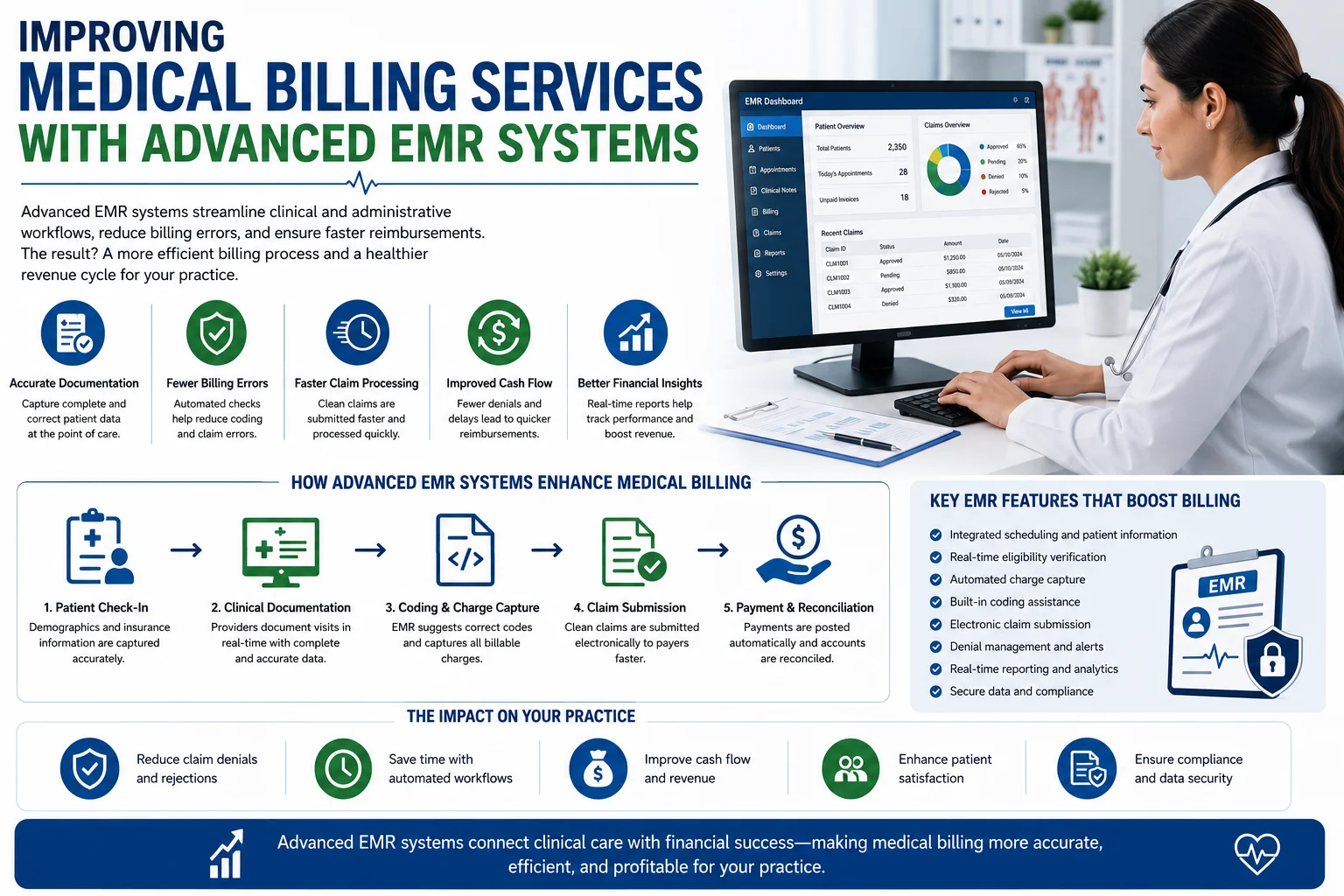
Likewise, in other fields, the healthcare industry has also transformed over the last decade with the latest technology. Patient expectations are evolving, regulations are becoming more complex, and providers are under increasing pressure to maintain financial stability while delivering exceptional care. But Advanced Electronic Medical Record (EMR) systems are changing that. Modern EMR platforms connect patients’ records directly to the billing processes that help them save from denied claims, late payments, and the headache of revenue cycle management.
Let’s show you how advanced EMR systems improve medical billing services and how healthcare providers and billing companies can use this technology for efficient claim processing.
What Is an EMR System?
An EMR (Electronic Medical Record) is a digital platform that healthcare providers use to store medical history, diagnoses, medications, treatment plans, and visit notes in one place. Unlike traditional paper records, EMRs allow healthcare providers to access and update patient information in real time.
EMR software first looks like a clinical tool. But it plays a bigger role in medical billing than most people know. Every claim or billing process that is sent to an insurance company starts with information. Now that information is captured in the EMR, including the diagnosis code, the procedure performed, the provider who performed it, and the documentation that supports medical necessity.
If that information is incomplete, mistyped, or disconnected from the billing system, the claim is likely to be denied or delayed. This is why the connection between EMR systems and medical billing services is so important. And when these two systems talk to each other properly, medical billing companies see their billing processes become faster, more accurate, and far less stressful for staff.
Common Medical Billing Challenges Without EMR Integration
Before looking at solutions, it helps to understand the problems that advanced EMR systems have resolved:
- Manual data entry errors: Staff retyping information from paper charts or disconnected systems into billing software leads to typos and mismatched codes.
- Claim denials and rejections: When code mismatches and incorrect diagnosis-to-procedure code pairing are used, missed modifiers, or expired insurance information are utilized, the claim directly becomes a denial claim.
- Slow reimbursement cycles: Your claims remain in a queue because documentation wasn’t ready when the claim was submitted, and that delay causes slow payments.
- Poor communication between departments: Front desk, clinical staff, and billing teams working off different versions of patient information that cause inconsistency and errors.
- Compliance risks: Incomplete documentation that doesn’t meet payer or HIPAA requirements has higher compliance risks.
- Limited visibility into revenue cycle performance: No easy way to see which claims are stuck, denied, or aging past 30, 60, or 90 days in manual entries.
These issues don’t just cost money but also affect patient trust when billing mistakes lead to confusing statements.
EMR vs. EHR: What’s the Difference?
People often use the terms EMR and EHR interchangeably, but they aren’t the same thing. An EMR (Electronic Medical Record) is a digital chart used within one practice. It holds the medical and treatment history for patients as seen by that specific provider.
An EHR (Electronic Health Record), on the other hand, is not designed specifically for one practice. It pulls together a patient’s information from multiple providers, labs, specialists, and hospitals into one shared record.
For billing purposes, the distinction is very slight, as both systems capture the diagnosis codes, procedures, and documentation that claims are built on. But an EHR’s broader interoperability can make it easier to gather complete documentation when a patient has been treated across multiple providers, which can support cleaner and better-documented claims.
How Advanced EMR Systems Improve Medical Billing Services
Automated Medical Coding Support
Modern EMR systems have built-in coding assistance features that suggest accurate ICD-10 and CPT codes based on the provider’s documentation. So you don’t need to guess or search through coding manuals, your system finds the most likely codes in real time. This automated medical coding support reduces coding errors that become the major cause of claim denials.
Real-Time Insurance Eligibility Verification
Advanced EMR platforms can check a patient’s insurance eligibility and benefits before the appointment even happens. This means front-desk staff already know whether a service is covered, what the copay will be, and whether prior authorization is needed or not. This eligibility verification prevents denied claims before they’re submitted.
Claims Scrubbing and Error Detection
Before you submit a claim, a good EMR-billing integration automatically scrubs it for errors like missing fields, mismatched codes, invalid modifiers, or incomplete patient information. If you find these issues before submission, you’ll see how your first-pass claim acceptance rate increases.
Seamless Clearinghouse Integration
Advanced EMR systems connect directly with clearinghouses, that means your claims are submitted electronically and tracked in real time. This reduces manual re-entry and makes each process fast from submission to payment timeline.
Interoperability Through HL7 and FHIR Standards
Modern systems are built on interoperability standards like HL7 and FHIR, which allow EMRs to securely share data with labs, pharmacies, hospitals, and billing platforms. This way stakeholders can keep working from the same accurate and up-to-date patient record. This reduces the telephone headaches that lead to billing mistakes.
AI-Powered Denial Management and Analytics
Some of the most advanced EMR systems now include predictive analytics that identify those claims likely to be denied before submission, based on patterns from past denials. This approach helps billing teams fix issues in advance rather than reacting after a denial letter arrives weeks later.
Better Documentation for Medical Necessity
Payers increasingly deny claims for a lack of medical necessity. EMR systems with structured templates and smart prompts help providers document thoroughly and consistently. This gives billing teams stronger support when claims are submitted or appealed.
The Connection Between EMR Systems and Revenue Cycle Management
Medical billing is not just the name of a single process. It is part of the larger Revenue Cycle Management (RCM) process which includes patient scheduling, insurance verification, documentation, coding, claim submission, and denial management.
Advanced EMR systems integrate all these functions into a unified workflow. This creates better communication between clinical and administrative teams and eliminates information silos.
When everyone works from the same platform then efficiency naturally improves.
Best EMR Features That Improve Medical Billing
If you’re evaluating EMR software for a healthcare practice or billing company, prioritize these features:
- Built-in billing and coding tools to support both patient care and medical billing.
- Real-time insurance eligibility checks to confirm patient coverage and benefits before treatment.
- Automatic claim error checks before claims are submitted to reduce denials.
- Direct connection to clearinghouses for faster and easier claim submission.
- Easy-to-read reports and dashboards to track claim denials, outstanding payments (A/R), and collections.
- HIPAA-compliant security to keep patient information safe and maintain audit records.
- Easy data sharing with labs, specialists, hospitals, and other healthcare systems.
- Patient portal where patients can view and pay their bills online.
- Mobile access so healthcare providers can update patient records using their smartphones or tablets.
Benefits of Combining Advanced EMR Systems with Medical Billing Services
When EMR and billing work together as one connected system, healthcare practices typically see:
- Fewer claim denials because patient information is more accurate and claims are checked for errors automatically.
- Faster payments as claims are submitted quickly without manual data entry.
- Less paperwork so staff can spend more time caring for patients instead of handling administrative tasks.
- Better cash flow because insurance payments are received sooner.
- Stronger compliance with organized documentation that meets payer and HIPAA requirements.
- A better patient experience through accurate bills and clear communication.
- Smarter business decisions with dashboards that show where claims or payments are delayed.
Best Practices for Integrating EMR with Medical Billing
- Choose a system built for both clinical and billing workflows, not just for one purpose.
- Train staff on the full workflow, not just their individual piece of it, so front desk, clinical, and billing teams all understand how their actions affect claims.
- Review denial reports weekly to find patterns early and adjust documentation or coding habits.
- Keep payer rules updated within the system as insurance requirements change often.
- Audit a sample of claims regularly to confirm coding accuracy and documentation quality.
- Use the patient portal actively to reduce phone calls and paper statements.
How Revantage Billing Helps Healthcare Practices Improve Billing Performance
Professional medical billing companies like Revantage Billing can maximize the value of EMR systems, as they have expertise in how technology and billing strategies work together.
At Revantage Billing, we understand that technology alone isn’t enough. Successful revenue cycle management depends on the right combination of advanced systems with experienced professionals and proven billing strategies. Our team works closely with healthcare providers to optimize overall billing operations.
Whether you’re a small clinic, specialty practice, or multi-provider organization, our customized medical billing solutions are designed to support sustainable growth.