
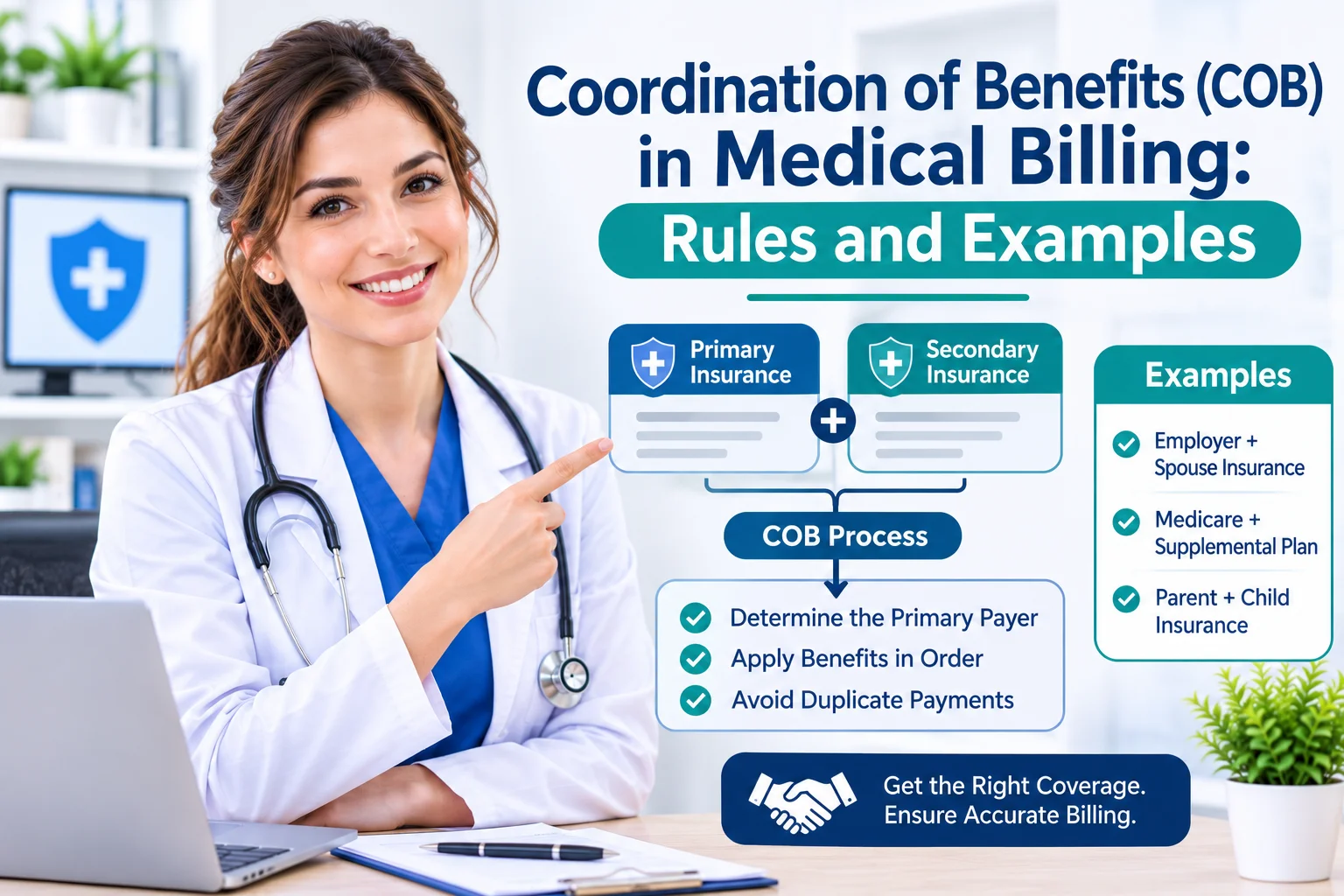
Quick Answer: What Is Coordination of Benefits (COB) in Medical Billing?
Coordination of benefits (COB) is the set of rules that decides which insurer pays first, second and third when a patient has more than one health plan and how much each plan pays, so combined payments never exceed the allowed amount. In medical billing, COB means verifying all coverage, billing in the correct order, sending the primary payer’s remittance data to the next payer, and reconciling the balance.
What Is COB in Medical Billing and Why Does It Matter?
When a patient has two or more health plans, someone has to decide who pays first. COB is that decision framework that makes this decision. It exists to prevent duplicate payment and to define each payer’s responsibility, and it is built from state insurance law, federal rules, plan contracts and payer policy.
Three basic rules apply to almost every COB situation:
- The order of payment is set by rules, not by patient preference.
- Total payments from all plans cannot exceed the total allowable expense.
- A secondary claim needs the primary payer’s adjudication details to be processed.
Importance of COB in Medical Billing
For a medical practices, COB errors cost money in four ways:
- Denials. Claims sent to the wrong insurance payer can be denied with CARC 22, which means another payer is responsible for payment.
- Delays. Secondary claims must wait until the primary payer processes the claim. Incorrect payer information can delay payments and increase accounts receivable.
- Recoupments. Insurance payers can take back payments months or years later if they find another payer should have paid first.
- Compliance Risks. Medicare providers must collect accurate insurance information and keep proper records to meet Medicare Secondary Payer requirements.
COB vs. Related Terms
| Term | What it means | How it differs from COB |
| Coordination of benefits (COB) | Rules that set payer order and prevent overpayment | The umbrella concept |
| Medicare Secondary Payer (MSP) | Medicare’s version of COB, based on Section 1862(b) of the Social Security Act | Applies only when Medicare is involved |
| Third-party liability (TPL) | Medicaid’s term for other payers responsible for the bill | Medicaid is always the payer of last resort |
| Crossover | Automatic forwarding of Medicare-adjudicated claims to Medigap or Medicaid | A transmission process, not a payer-order rule |
| Cost avoidance vs. pay-and-chase | Medicaid either denies the claim until other insurance pays, or pays first and recovers later | Recovery methods used after COB is identified |
| Subrogation | A payer’s right to recover from a liable third party (such as an auto insurer) | Recovery of money, not order of payment |
Who Pays First? The Commercial COB Rules (NAIC Model)
Most state COB regulations follow the NAIC Coordination of Benefits Model Regulation (Model 120). Payers apply the rules below in order and stop at the first one that settles the question. A plan without a COB provision is generally primary.
Common COB Rules for Determining the Primary Payer
- Non-dependent vs. dependent rule: The plan covering a person as an employee or subscriber pays first, before the plan covering them as a spouse or dependent.
- Birthday rule (child covered by both parents): The plan of the parent whose birthday comes earlier in the calendar year pays first. Only the month and day count. If both birthdays are the same, the plan that covers the parent longer pays first.
- Divorced, separated, or unmarried parents: The plan named in the court order pays first. The order of payment depends on the child’s custody and applicable court requirements.
- Active vs. retired or laid-off employee: The plan covering the person as an active employee generally pays first, rather than the plan covering them as a retired or laid-off employee.
- COBRA or state continuation coverage: The plan covering the person as an active employee or dependent generally pays before COBRA coverage.
- Longer vs. shorter coverage: The plan that has covered the person longer pays first. The coverage period starts from the original enrollment date, not the latest renewal date.
- When no other rule applies: Both plans generally share allowable expenses equally. This situation is uncommon, so confirm the payment order with the insurance payer.
Child coverage when parents are divorced or separated
- A court decree that makes one parent responsible for health care then that parent’s plan is primary.
- A decree making both parents responsible, or joint custody without specifics then the birthday rule applies.
- No decree then the custodial parent’s plan pays first, followed by their spouse’s plan, the non-custodial parent’s plan, and then their spouse’s plan.
- Payers apply a decree only after they receive notice of it, so collect a copy of the relevant pages.
Three Important COB Rules to Know
- Self-funded employer plans: These plans generally follow their own plan documents rather than state insurance rules. Always check the plan details.
- Different state laws: COB rules vary by state. Some states set rules for plans without COB provisions and limits on recovering overpayments.
- Medical vs. dental coverage: Medical and dental plans do not always work together. For example, jaw fractures usually fall under medical coverage, while some procedures, such as biopsies, are billed to both plans. Check deductibles and copays before deciding which plan to bill first.
Medicare Secondary Payer (MSP) Rules: When Medicare Pays Second
Medicare is primary unless a law makes another payer responsible first. The most common situations involve employer group health plans (GHPs).
- Age 65 or older, patient or spouse actively working: If the employer has 20 or more employees, the employer’s group health plan (GHP) pays first.
- Age 65 or older, employer has fewer than 20 employees: Medicare pays first.
- Under 65 with a disability, patient or family member actively working: If the employer has 100 or more employees, the employer’s group health plan pays first.
- Under 65 with a disability, the employer has fewer than 100 employees: Medicare pays first.
- End-Stage Renal Disease (ESRD): The employer’s group health plan or COBRA coverage pays first during the first 30 months.
- ESRD after 30 months: Medicare pays first.
- Retiree coverage or COBRA (age or disability): Medicare generally pays first, regardless of employer size.
Multi-employer plan exception: Employers with fewer employees can still have primary coverage if they participate in a multi-employer plan where at least one employer meets the required employee limit. This applies to both the 20-employee and 100-employee rules.
ESRD 30-month rule: The 30-month period starts when a person first becomes eligible for Medicare Part A due to ESRD. This rule applies regardless of employer size or employment status. During this period and afterward, the health plan cannot treat people with ESRD differently from other members.
Other Primary Payers and Medicare Secondary Payer (MSP) Codes
- Code 14 – No-Fault Insurance: Applies when an injury results from a no-fault situation, including an auto accident.
- Code 15 – Workers’ Compensation: Applies when a patient receives care for a work-related injury or illness.
- Code 16 – Public Health Service or Federal Agency: Applies when a federal agency provides or arranges the patient’s healthcare.
- Code 41 – Black Lung Benefits: Applies when the federal Black Lung program covers the medical service.
- Code 42 – Veterans Administration (VA): Applies to VA-related healthcare. Medicare or the VA may pay for a service, but not both.
- Code 47 – Liability Insurance: Applies when an injury or illness results from an accident or situation covered by liability insurance.
Conditional Medicare Payments
If a liability, no-fault, or workers’ compensation payer does not pay on time, Medicare makes a conditional payment. Medicare can later recover this money from the primary payer or settlement.
How Secondary Payment Is Calculated
Secondary payment depends on the method used by the insurance plan. Commercial plans follow three common methods: standard COB which pays the remaining allowable balance, carve-out which subtracts the primary payment from what the secondary plan would have paid as primary, and non-duplication which pays nothing if the primary payment meets or exceeds its normal benefit.
Medicare uses the lowest-of-three rule (42 CFR 411.33 and the MSP Manual), considering the billed charge, Medicare’s allowed amount, and the higher of Medicare’s or the primary payer’s allowed amount, after subtracting the primary payment. Medicare never pays more as secondary than it would have paid as primary.
The 9-Step COB Workflow for Billing Teams
- Ask every patient about other coverage at every visit. CMS tells providers to gather MSP information by asking, and institutional providers to have patients update insurance profiles at each visit.
- Run eligibility (270/271). An eligibility response does not replace MSP questions because CMS states that checking the eligibility file does not absolve the provider of asking them.
- Document the answers. Keep the questionnaire, card copies, decrees and employer-size information.
- Determine order. Apply the NAIC rules or MSP tables above and record the reason for the order, not just the result.
- Bill the primary payer with the correct filing indicator and confirm acceptance.
- Post the 835 and capture the CAS segments, paid amount and adjudication date.
- Bill the secondary payer with the primary payer’s data (or attach the EOB for paper claims) and make sure the amounts balance.
- Reconcile and bill the patient only for PR amounts that remain after all payers, subject to contracts and QMB protections.
- Update the payer when coverage changes, and respond quickly to payer COB questionnaires, because delays can suspend claims.
How Revantage Billing Helps With COB
COB errors can lead to claim denials, delayed payments, and lost revenue. Revantage Billing helps prevent these problems through accurate insurance verification, claim scrubbing, secondary claim submission, and denial follow-ups. Our team checks payer order, MSP codes, and adjustment details to help keep claims accurate and payments on track. If your practice is facing CO-22 or N479 denials, contact Revantage Billing for COB denial review.