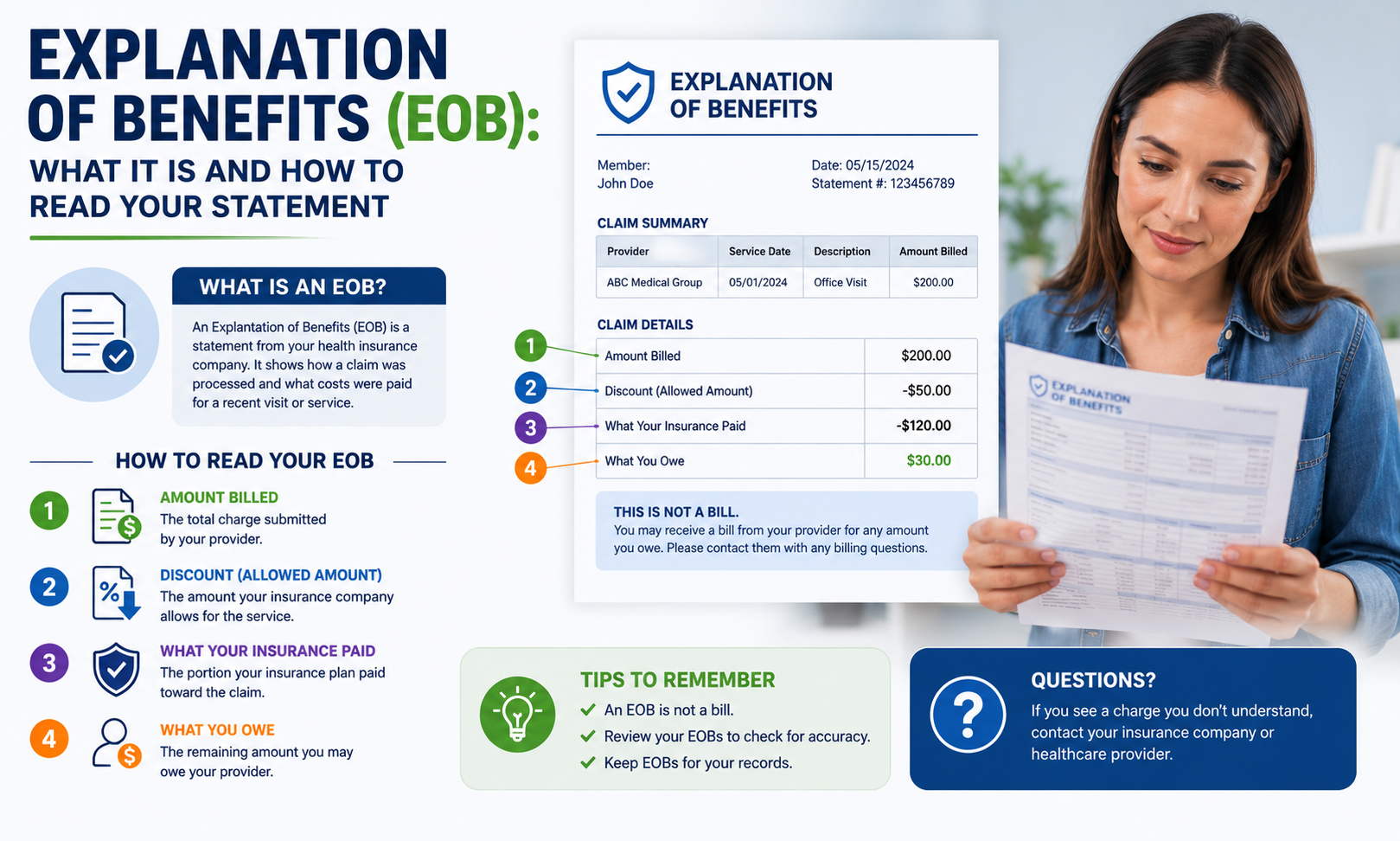
When you visit a doctor, you actually get a letter from your health insurance company, see different numbers and medical terms on it. This letter is called an Explanation of Benefits (EOB) that you receive after a hospital stay, lab test, or medical procedure, and you aren’t quite sure what it’s about. It contains all the information relevant to healthcare, billing codes, insurance calculations, and multiple dollar amounts that can make even a simple medical visit seem complicated.
The majority of people are unaware that the purpose of EOB is to assist you in understanding the processing of your insurance claim. It becomes a useful tool for monitoring medical costs, detecting billing mistakes, and figuring out what you might owe after you learn how to read it. Let’s go over everything you need to know about an Explanation of Benefits, such as what it is, why you get it, and how to read each section.
What Is an Explanation of Benefits (EOB)?
An Explanation of Benefits (EOB) is a statement sent by your health insurance company after it processes a medical claim submitted by your healthcare provider.
The EOB explains:
- Which medical services were provided?
- The amount that the provider charged
- What is covered by your insurance?
- Any applicable reductions or modifications
- The total amount that you might have to pay
One of the biggest misconceptions patients have is that an EOB is a bill.
But it isn’t.
An EOB is simply an informational document that shows how your insurance company handled the claim.
The actual bill normally is provided by your healthcare provider, even though it can indicate that you owe a particular amount. It functions similarly to a summary of the costs associated with your medical appointment.
Why Do Insurance Companies Send EOB Statements?
Insurance companies send EOB statements to create transparency in the healthcare payment process. In medical billing, different entities are involved:
- The patient
- The healthcare provider
- The insurance company
After treatment, your provider submits a claim to your insurance carrier. The insurer reviews the claim and sees:
- Whether the service is covered
- Whether prior authorization was required
- How much is payable under the plan
- What portion is the patient’s responsibility
The EOB communicates these decisions to you.
Without an EOB, patients would have little visibility into how their insurance benefits are being used.
What Information Is Included in an EOB?
The layouts vary among insurance companies but most EOB statements contain similar information.
Common sections include:
Patient Information
This section identifies:
- Patient name
- Member ID number
- Policy number
- Group number
- Date of service
Always verify that this information is accurate.
Even a small mistake can lead to claim processing issues.
Provider Information
You’ll see details about the healthcare provider who delivered the service, such as:
- Physician name
- Clinic name
- Hospital name
- Laboratory or imaging center
This confirms which provider submitted the claim.
Claim Number
Each processed claim has a unique claim number.
This number can be helpful if you need to contact your insurance company regarding the claim.
Description of Services
The EOB outlines the healthcare services you received like your office visits, laboratory testing, X-rays, surgical procedures, physical therapy, and emergency room treatment.
You can see service descriptions or billing codes associated with the treatment.
Review this section carefully to ensure the listed services match what you actually received.
Amount Charged
This shows the total amount billed by the healthcare provider.
Many patients are surprised by these figures because healthcare providers mostly bill more than the amount ultimately paid by insurance. The charged amount isn’t necessarily what you’ll owe.
Allowed Amount
The allowed amount is the maximum payment approved under your insurance plan’s agreement with the provider.
For example:
- Provider Charge: $500
- Insurance Allowed Amount: $300
The difference can be written off if the provider is in-network.
That’s why insurance can reduce healthcare costs.
Insurance Payment
This section shows the amount paid by the insurance company.
For example:
Allowed Amount: $300
Insurance Pays: $240
Patient Responsibility: $60
This amount is sent directly to the provider in most cases.
Patient Responsibility
This is the amount you may owe.
It can include:
- Deductibles
- Copayments
- Coinsurance
- Non-covered services
Many people focus on this section first because it directly affects their out-of-pocket costs.
Example of an EOB
Let’s understand EOB in more simple way through an example:
- Office Visit Charge: $250
- Allowed Amount: $180
- Insurance Payment: $144
- Coinsurance (20%): $36
- Provider Adjustment: $70
- Patient Responsibility: $36
What happened?
The provider charged $250.
Your insurance agreement reduced the approved amount to $180.
Insurance paid 80%, which equals $144.
You are responsible for the remaining 20%, or $36.
The extra $70 was adjusted off under the provider’s contract.
Now you see why the amount charged isn’t necessarily the amount you’ll pay.
Understanding Key EOB Terms
To properly read an Explanation of Benefits statement, it’s important to understand some common insurance terms.
Deductible
The amount you have to pay before your insurance starts to share costs is known as your deductible.
For example:
Annual Deductible: $1,500
According to your plan advantages, if you have only paid $500 toward it, you still have $1,000 left until insurance begins to pay.
A lot of EOBs show the amount of your deductible that has been paid.
Copayment (Copay)
A copayment is a set amount of money you have to pay for medical services.
For Example:
- $25 primary care visit
- $50 specialist visit
- $15 prescription copay
Typically, copays are required at the time of service.
Coinsurance
Coinsurance represents a percentage of healthcare costs shared between you and your insurance company.
For Example:
- Insurance pays 80%
- Patient pays 20%
If the approved amount is $500:
- Insurance pays $400
- Patient pays $100
Your EOB will typically show this calculation.
Out-of-Pocket Maximum
This is the maximum amount you will pay for covered services over the duration of a plan year.
Once reached, your insurance will cover 100% of eligible charges.
A lot of EOB statements monitor how close you are to reaching this limit.
Network Provider
An in-network provider and your insurance company have negotiated costs. Due to these providers, patients usually pay less.
Patient accountability increases when using out-of-network providers.
How to Read an EOB Step by Step
Let’s show you the process of reading an Explanation of Benefits statement.
Step 1: Verify Patient Information
Start by checking:
- Name
- Policy number
- Date of service
If you find any inaccuracies here you should report them immediately.
Step 2: Review Services Rendered
Confirm that all listed services were actually received.
Look for:
- Duplicate charges
- Incorrect procedures
- Services you never received
Billing mistakes happen more frequently and most people never know this.
Step 3: Compare Charges and Allowed Amounts
Notice the difference between:
- Provider charge
- Insurance allowed amount
This helps you understand how insurance negotiates the pricing.
Step 4: Check Insurance Payments
Review the amount that your insurance provider paid.
Verify that the payment matches with the benefits of your plan.
Step 5: Identify Patient Responsibility
Find the part that displays your potential debt.
Eventually, this amount is needed to equal the bill that the provider sends you.
Get in touch with the billing department if you don’t receive an aligned bill.
EOB vs Medical Bill: What’s the Difference?
This is one of the most common questions patients ask. The EOB tells you what happened.
The medical bill tells you what you need to pay.
Explanation of Benefits (EOB)
- Sent by the insurance company
- Explains claim processing
- Not a bill
- Shows payment breakdown
Medical Bill
- Sent by healthcare provider
- Requests payment
- Contains due date
- Includes payment instructions
Always compare both documents before making a payment.
Common EOB Errors Patients Should Watch For
Healthcare billing isn’t perfect. Reviewing your EOB carefully can help catch errors before they become costly. Some common EOB errors include:
- Duplicate Claims
- Incorrect Patient Information
- Services Not Received
- Coverage Denials
- Incorrect Patient Responsibility
What Should You Do If You Disagree With an EOB?
An EOB is not necessarily the final word. If you believe something is incorrect, don’t panic first and do:
Contact Your Provider
Ask the billing office for clarification. Sometimes, coding or claim submission errors can be corrected quickly.
Contact Your Insurance Company
Speak with a customer service representative. Request a detailed explanation.
Keep notes regarding:
- Date of call
- Representative name
- Reference number
Request a Claim Review
Insurance companies often allow claim reconsiderations.
This can result in corrected payments.
File an Appeal
Your insurance policy can provide you with the right to appeal if a claim is unjustly rejected.
After more proof is provided, many rejected claims are eventually accepted.
Electronic EOBs: The Digital Future
Today, many insurance companies offer electronic Explanation of Benefits statements through online member portals. That provides you with more flexibility. It can be easily and quickly accessed, reduces paper clutter, easy record keeping, and offers secure online storage.
Patients can often:
- View claims history
- Download EOBs
- Track deductibles
- Monitor out-of-pocket costs
Digital access makes managing healthcare finances much easier.
The Role of EOBs in Medical Billing
For medical billing professionals, EOBs are a critical part of revenue cycle management. You can easily find:
- Claim approval status
- Insurance reimbursements
- Contract compliance
- Patient balances
- Denial trends
Businesses that thoroughly examine EOBs frequently see increased patient satisfaction, better cash flow, quicker payments, and fewer billing problems.
At Revantage Billing, EOB management is an important component of ensuring providers receive accurate reimbursement while helping patients understand their financial responsibilities.
Tips for Keeping Your EOB Records Organized
Managing healthcare paperwork is an important step. You can manage them simply if you:
- Create a Dedicated Folder
- Save Digital Copies
- Match EOBs With Bills
- Track Annual Spending
- Review Every Statement