Quick answer:
A 104 NP is a California nurse practitioner (NP) who is approved by the California Board of Registered Nursing (BRN) to practice independently. This means nurse practitioners can treat patients without physician supervision or standardized procedures. It does not matter where they work.
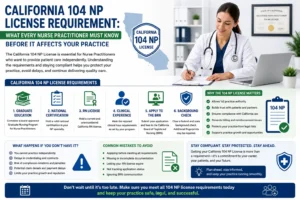
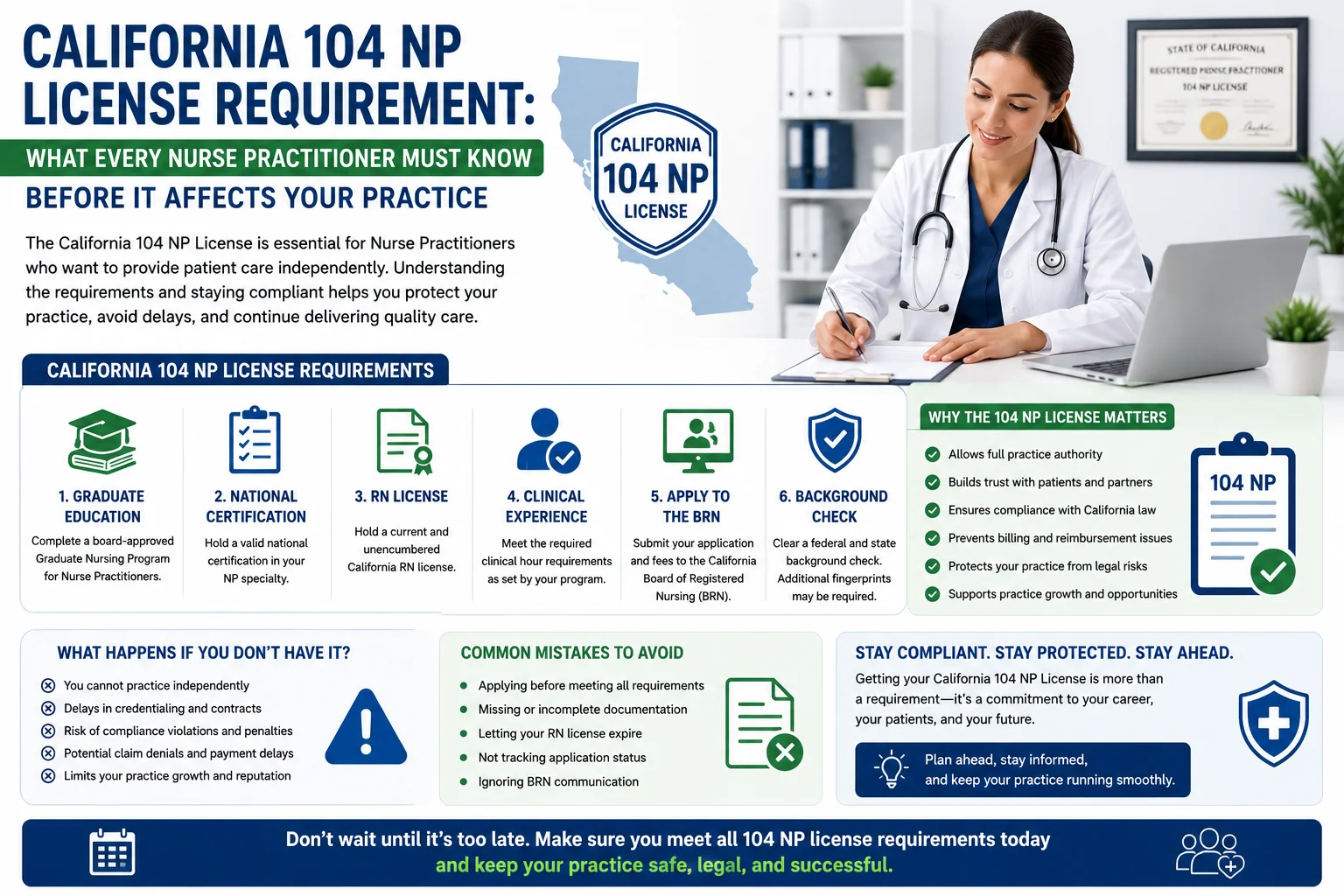
To become a 104 NP, the nurse practitioner must:
First earn 103 NP status and remain in good standing.Work as a 103 NP for at least 3 full-time years or 4,600 hours.
The BRN started accepting 104 NP applications on January 1, 2026, after California passed AB 890 in 2020 and later updated the law through SB 1451, which took effect on January 1, 2025.
California has been making new changes to nurse practitioner (NP) practice laws over the last few years. One of the biggest developments has been the implementation of AB 890, specifically introduced for nurse practitioners and billing experts. It affects who can run a practice, how insurance claims are billed, which payer contracts you need, and who is responsible for patient care.
As these regulations continue evolving, many healthcare providers are now asking questions about the California 104 NP license requirement, how it works, and what it means for their practice. So let’s clear up all your questions.
Table of Contents
- What Is a 104 NP?
- 103 NP vs. 104 NP: The Full Comparison
- 104 NP Eligibility Requirements
- The 104 NP Application Process
- What Actually Changes for Your Practice
- Billing and Reimbursement Impact of 104 NP Status
What Is a 104 NP?
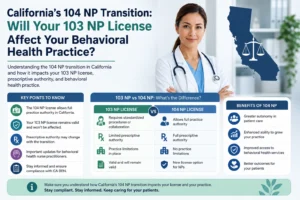
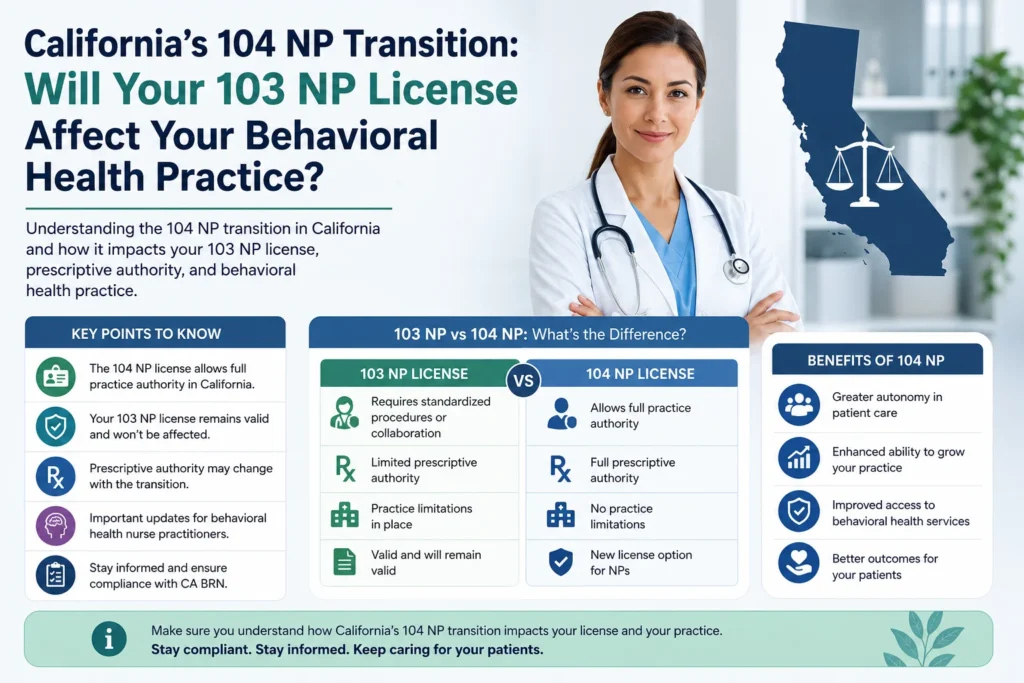
In the past, California nurse practitioners (NPs) had to work under standardized procedures. These are written rules that require a supervising or collaborating physician to approve and oversee many of the NP’s clinical decisions. But in September 2020, California passed Assembly Bill 890 (AB 890), which took effect on January 1, 2023. This law created a two-step way through which NPs can practice with more independence:
- 103 NP (Business and Professions Code 2837.103): A nurse practitioner can practice without standardized procedures but only in an approved healthcare setting, such as a medical group, clinic, hospital, or physician-owned professional corporation that includes at least one physician.
- 104 NP (Business and Professions Code 2837.104): A nurse practitioner can practice independently without standardized procedures and does not need to work in a group setting. A 104 NP can open and own their own practice, work solo, and treat patients without any supervising physician.
But remember 103 NP and 104 NP are additional certifications for California nurse practitioners. They do not replace your California RN license, NP license, or national NP certification. So all these are necessary for you to qualify.
Who Can Get 103 or 104 NP Status?
The California Board of Registered Nursing (BRN) certifies five types of Advanced Practice Registered Nurses (APRNs):
- nurse practitioners (NPs)
- certified nurse-midwives (CNMs)
- certified registered nurse anesthetists (CRNAs)
- clinical nurse specialists (CNSs)
- psychiatric-mental health nurse practitioners (PMHNPs)
The 103 NP and 104 NP certifications apply only to nurse practitioners (NPs).
Why This Matters for Medical Billing and Revenue Cycle Management
Many providers don’t realize that licensing regulations can directly impact reimbursement.
Credentialing and payer enrollment depend heavily on proper licensing status. If an NP fails to meet state requirements or maintain appropriate documentation, they face different billing challenges. Potential consequences include:
- Claim denials
- Delayed reimbursements
- Payer credentialing problems
- Compliance audits
- Increased administrative burden
That’s why strong revenue cycle management becomes essential. Healthcare organizations need to monitor provider licensing status just as carefully as coding and claim submission processes.
104 NP Eligibility Requirements
To qualify for 104 NP certification, an applicant must meet the following eligibility criteria:
- Hold current and unencumbered 103 NP certification with the California BRN.
- To qualify for 104 NP status, you must have worked as a 103 NP in good standing for at least three years. These three years do not include the experience you used to qualify for 103 NP status. However, if you have a Doctor of Nursing Practice (DNP) degree, the California Board of Registered Nursing (BRN) can count some of your direct patient care hours completed during your doctoral program toward the three-year requirement.
- Keep your national NP certification active in your specialty area like Family, Adult-Gerontology, Psychiatric-Mental Health, or Pediatrics. 104 NP status does not expand your scope of practice, you can only treat the patient groups covered by your certification.
- Carry professional liability (malpractice) insurance that matches your practice setting.
- Complete the required continuing education (CE). From 2025, NPs who provide primary care to practices where 25% or more of patients are age 65 or older must complete additional CE hours in gerontology.
- Create a written consultation plan that explains how you will consult or collaborate with physicians or other healthcare providers when handling complex patient cases. This is not a supervision requirement but it’s simply a document you must keep on file for compliance.
If you’re moving to California from another state, you cannot practice using a Nurse Licensure Compact (NLC) license because California is not part of the NLC. You must first get a California RN license through endorsement and then apply for California NP (APRN) certification with the Board of Registered Nursing (BRN). Only after receiving your California NP certification can you begin working toward 103 NP and later 104 NP status.
The 104 NP Application Process
The exact application requirements can change but the process usually looks like this:
- Make sure your 103 NP status is active and in good standing. You should have no disciplinary actions, complaints, or expired credentials.
- Show that you’ve worked as a 103 NP for at least 3 years or 4,600 hours. You’ll need to complete the BRN’s required attestation forms. The work hours can be verified by a licensed physician, a 103 NP, or a 104 NP. They only confirm that you completed the required hours, they do not evaluate your clinical skills.
- Submit your 104 NP application through the California Board of Registered Nursing (BRN) portal with proof of your national NP certification, professional liability insurance, and DNP documentation if you’re using DNP patient care hours toward the requirement.
- Complete a Live Scan fingerprint background check if you haven’t already done one for your California RN or 103 NP application.
- Wait for the BRN to review your application. Processing times can change and because 104 NP applications started in 2026 then approval mostly takes longer than a standard license renewal.
- Apply for a furnishing number if you plan to prescribe medications, including controlled substances. This requires completing an approved advanced pharmacology course and getting a DEA registration if you will prescribe controlled substances.
A furnishing number is not automatically included with your 104 NP certification.
Billing and Reimbursement Impact of 104 NP Status
For a healthcare practice, getting 104 NP status gives you more independence but it also changes how you bill insurance and get paid. At Revantage Billing, this is where we spend most of our time with California NP clients making this move. Here are the most important things to know:
You can’t use incident-to billing when practicing independently
Incident-to billing allows a physician to bill Medicare at 100% of the physician fee schedule for services provided by a nurse practitioner (NP). However, this is only allowed if:
- The physician started the patient’s treatment plan.
- The physician is physically present in the office when the NP sees the patient.
- The visit takes place in an outpatient office or clinic, not a hospital or other facility.
If you own your own practice and don’t work under a physician, you cannot use Medicare’s incident-to billing. Instead, all claims must be billed under your own National Provider Identifier (NPI).
Medicare usually pays 85% of the physician rate
When a nurse practitioner (NP) bills Medicare using their own National Provider Identifier (NPI), Medicare usually pays 85% of the physician fee schedule, not the full 100%.
If you’re becoming a 104 NP and leaving a physician-supervised practice, this can affect your income because you can no longer use incident-to billing, which allows Medicare to pay the full physician rate.
Before opening your own practice, compare the lower Medicare reimbursement with the money you’ll save by practicing independently, such as not paying physician supervision or revenue-sharing fees. This will help you decide whether independent practice makes financial sense for you.
Complete payer credentialing before seeing patients
Before billing insurance, you must be credentialed with each insurance company in your own name. This includes commercial insurers and Medi-Cal managed care plans. Credentialing often takes 60 to 120 days for each payer and claims submitted before approval are usually denied.
Payment rates vary by insurance company
Unlike Medicare’s standard 85% payment, Medi-Cal and commercial insurance plans have different payment rules. Some pay NPs the same as physicians, while others pay a percentage that is less. Check each payer’s reimbursement policy before you start billing.
Bill under the correct provider to avoid legal problems
When you become a 104 NP, you should bill Medicare under your own NPI, not a physician’s.
The Office of Inspector General (OIG) checks Medicare claims to make sure incident-to billing is used correctly. If your independent patient visits are billed under a physician’s NPI because of habit, delayed credentialing, or a billing mistake, your practice could face audits, claim denials, fines, or False Claims Act violations.
Don’t use incident-to billing while waiting for your own insurance credentialing to be approved.
Set up your own business for billing
Most 104 NPs who open an independent practice need to create a Nursing Professional Corporation. This means you’ll need to set up your own billing NPI, Tax ID, and new contracts with insurance companies. You cannot continue using your previous employer’s billing information or group NPI. Instead, you’ll need to complete a new credentialing and contracting process before you can bill under your new practice.
Keep the right documentation
As a 104 NP, your documentation is different from incident-to billing. So instead of showing that a physician supervised your work, your records should show that you have a written plan for consulting or referring patients to a physician or another healthcare provider when a case is complex and inform all new patients that they are being treated by a nurse practitioner (NP).
Insurance companies can review your records during audits to make sure you meet these requirements.
Get Your Billing Ready for 104 NP Status
If you want to become a 104 NP, you also need to prepare your billing system. Before you start seeing patients, make sure your payer credentialing, NPI setup, insurance contracts, and Medi-Cal enrollment are all set. If these steps aren’t completed in the right order, your claims could be denied or delayed. Here you need Revantage Billing, which helps California nurse practitioners transition to 103 and 104 NP status by handling credentialing, payer enrollment, and claim submission. If you’re planning to become a 104 NP, it’s best to contact us before submitting your application so your billing is ready from day one.
Frequently Ask Questions
When can California NPs apply for 104 NP status?
California nurse practitioners can apply for 104 NP status starting January 1, 2026. This is when the California Board of Registered Nursing (BRN) started accepting applications after the first group of 103 NPs completed the required three years of practice.
How long does it take to become a 104 NP?
For most NPs, it takes about six years. 3 years or 4,600 hours to qualify for 103 NP status. Another 3 years working as a 103 NP in good standing before applying for 104 NP status. If you have a Doctor of Nursing Practice (DNP) degree, some of your clinical training hours can count toward the first three-year requirement.
Does 104 NP status let me bill Medicare at the physician rate?
No. When a 104 NP bills Medicare under their own NPI, Medicare generally pays 85% of the physician fee schedule. The 100% payment rate is only available through incident-to billing which usually isn’t an option for independently practicing 104 NPs.
Do I need a supervising physician as a 104 NP?
No. A 104 NP does not need a supervising physician or standardized procedures. However, you must have a written plan explaining how you’ll consult or refer patients to other healthcare providers when dealing with complex cases.
Is California part of the Nurse Licensure Compact (NLC)?
No. California is not a Nurse Licensure Compact (NLC) state. If you’re moving from another state, you must first get a California RN license by endorsement and then apply for California NP (APRN) certification before you can start working toward 103 NP and 104 NP status.