For many years, California nurse practitioners (NPs) worked under strict rules. They needed physician-approved standardized procedures and physician supervision for most patient care decisions. For behavioral health practices, NP licensing, scope of practice, credentialing, payer enrollment, documentation, and billing are all connected. When an NP’s status changes, practices should update their records and billing processes to avoid administrative or payment issues.
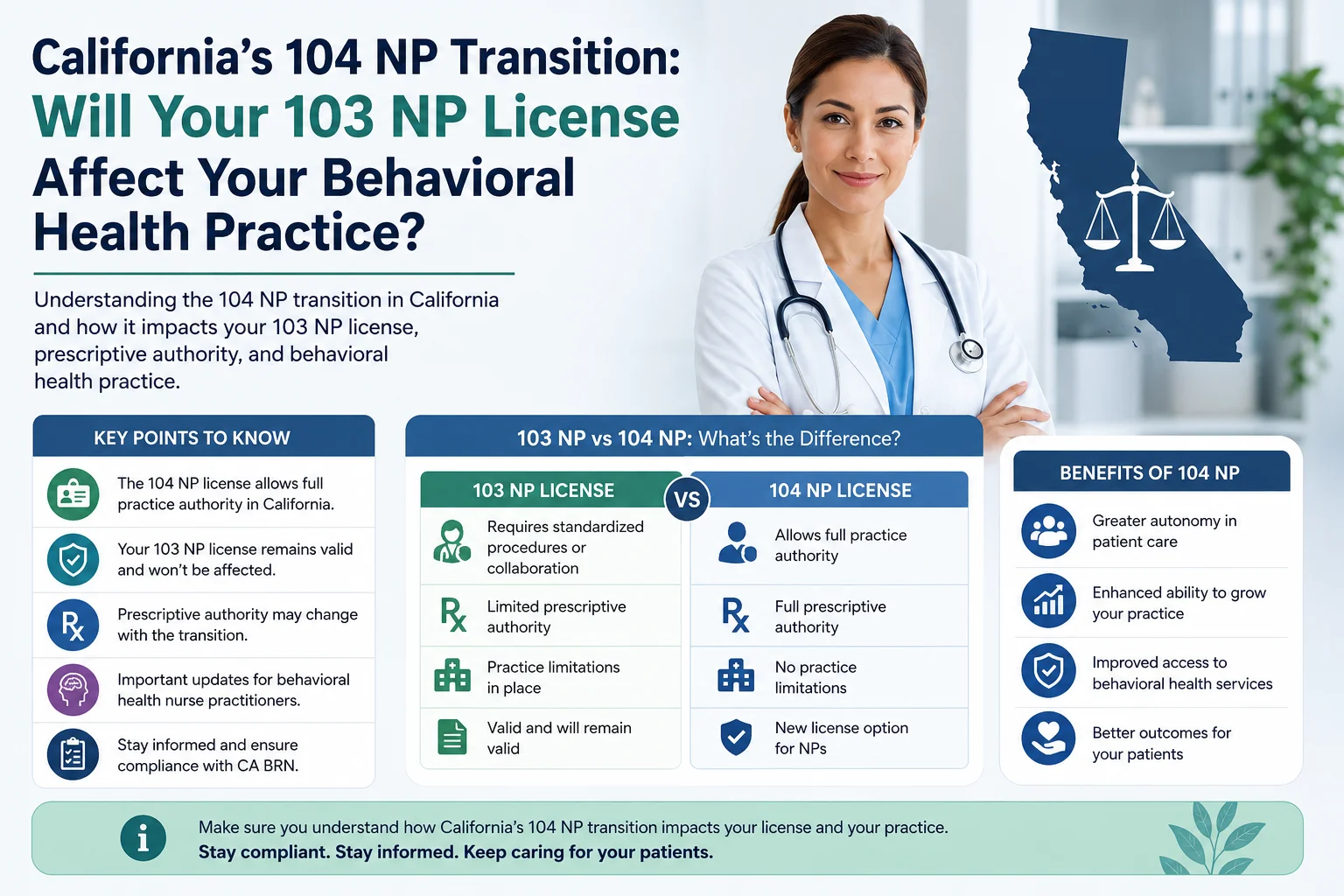
California’s Assembly Bill 890 (AB 890) introduced two new NP categories, including 103 NP and 104 NP. A 103 NP can practice without standardized procedures in approved healthcare settings, while a 104 NP can practice independently in more settings, as long as they work within their national certification. Let’s discuss what this transition means if you’re running or managing a behavioral health practice.
What Are the 103 and 104 NP Licenses?
Assembly Bill 890 (AB 890) which was signed in 2020, was created to give California nurse practitioners (NPs) more independence and ability to work individually. But the rollout was slow and many NPs found it difficult to qualify because of the early rules.
To fix these issues, Governor Newsom signed Senate Bill 1451 (SB 1451) in September 2024. The law took effect on January 1, 2025, and made the process clearer and easier.
These laws created two new NP certification levels:
- 103 NP: A nurse practitioner who can practice without standardized procedures but only in approved group healthcare environments like medical practices, clinics, hospitals, home health agencies, or medical corporations. A 103 NP still works with a collaborating physician.
- 104 NP: A nurse practitioner who has worked as a 103 NP for at least three years or 4,600 hours in good standing. A 104 NP can practice independently without a collaborating physician, standardized procedures, or a group setting, as long as they work within their certified specialty.
The California Board of Registered Nursing started accepting 104 NP applications on January 1, 2026. This is because the required three years of experience as a 103 NP had to be completed first. As a result, 2026 is the first year many NPs are moving through from RN to 103 NP and then to 104 NP.
Why California 103 NP and 104 NP Matter for Behavioral Health Practices
Psychiatric Mental Health Nurse Practitioners (PMHNPs) are one of the six NP specialty areas recognised under AB 890, along with family, adult-gerontology, neonatal, pediatrics, and women’s health. This makes PMHNPs one of the most affected groups where the transition under these new rules can have practical consequences.
- More demand for mental health care: California is expanding access to mental health services through programs that support PMHNPs, especially in underserved communities. It allows PMHNPs to practice independently and helps more patients get care.
- More independent practices: Many PMHNPs now work in private practices, telehealth clinics, or NP-owned clinics. The 104 NP allows eligible PMHNPs to own and run these practices without needing or depending on a physician as the majority owner.
- Billing is already complicated: we already know that mental health billing includes time-based CPT codes, prior authorizations, and different payer rules. Changes in NP supervision can make billing even more complex. If practices don’t track whether an NP is a 103 NP or 104 NP then claims can easily be delayed or denied.
If your behavioral health practice employs nurse practitioners or you’re a PMHNP starting your own practice, then the provider’s 103 NP or 104 NP status affects how services are billed, who is listed on claims, and whether the claims meet payer requirements.
103 NP Requirements: The Transition to Practice
Before a nurse practitioner (NP) can apply for 103 NP status, they must complete a Transition to Practice (TTP) period. SB 1451 has made these requirements much clearer.
- Experience required: At least 4,600 hours, which is about three years of full-time practice that allows them to provide direct patient care in California within the last five years.
- Hours don’t have to be continuous: The hours can be earned over time. Career breaks, part-time work, or changing jobs won’t affect eligibility.
- Where the hours can be earned: Qualifying experience includes clinics, hospitals, home health agencies, medical group practices, state hospitals, medical foundations, and other approved healthcare practices.
- Written attestation: The NP needs a signed statement from a supervising physician, a 103 NP, or a 104 NP confirming the required hours were completed. They just confirm the hours, not evaluating the NP’s clinical skills.
- Flexible experience: The required hours can be from different patient populations or practice settings. They don’t have to be in one specialty.
After receiving 103 NP certification, an NP can practice without standardized procedures but only in an approved group healthcare setting that includes at least one physician. A 103 NP cannot open or run an independent clinic.
104 NP Requirements: Full Independence
To move from 103 to 104 status, an NP must:
- Hold active 103 NP certification in good standing.
- Complete an additional three full-time-equivalent years of direct patient care as a 103 NP.
- Submit a 104 NP application to the BRN which the Board began formally processing starting from January 1, 2026.
Once their application is approved, a 104 NP can practice entirely on their own without any need for a supervising physician, group setting requirement, and standardized procedures within their certified population focus. For a PMHNP, that means the ability to independently diagnose, treat, and prescribe for behavioral health conditions without a collaborating psychiatrist.
Practice Ownership: CPOM, MSOs, and Nursing Corporations
Behavioral health practices must follow both billing rules and business ownership laws.
- 103 NP: A 103 NP cannot fully own a medical practice. They must work with a physician-owned or physician-led practice where they share the interest. Physicians hold the majority of the revenue while the NP holds a minority interest. But they can own a 100% Management Services Organization (MSO) to manage non-clinical tasks like billing, marketing, staffing, and administration.
- 104 NP: A 104 NP has more independence and can fully own a Nursing Professional Corporation. But a nurse-owned corporation generally cannot employ physicians directly, so practices with both NPs and psychiatrists often need separate business entities.
For behavioral health practices shifting to 104 NP, it’s not just the license that changes. The business structure, billing setup, NPI records, and insurance contracts also need to be updated.
Billing and Reimbursement: What Actually Changes
This is one of the biggest changes for behavioral health practices because it directly affects the billing and revenue cycle of practices.
For 103 NPs: Billing Stays Mostly the Same
- A 103 NP can continue to bill under their own NPI as a non-physician provider.
- Medicare and Medi-Cal billing rules generally do not change.
- The main difference is that standardized procedures are not required so the documentation becomes simpler. And the billing mechanics like NPI enrollment, fee schedule percentage, and claim submission process don’t change.
For 104 NPs: Independent Billing
When an NP becomes a 104 NP, billing actually changes more significantly.
- Independent billing: 104 NP bills under their own NPI as the standard approach.
- No more incident-to billing: Since a 104 NP no longer works under physician supervision so services usually cannot be billed under a physician’s NPI.
- Medicare payments: Medicare typically pays NPs 85% of the physician fee schedule when they bill under their own NPI. This reduces reimbursement compared with incident-to billing.
- Medi-Cal: NPs can continue to bill Medi-Cal directly, just as they could before.
- Commercial insurance: Each insurance company has its own rules. Some pay NPs the same as physicians while others pay less. That’s why practices should check each payer’s policy.
- Credentialing: A 104 NP must still complete credentialing and join each insurer’s provider network before billing independently.
Why It Matters for Behavioral Health
Behavioral health billing is already complex because of time-based CPT codes, psychotherapy add-on codes, and prior authorization requirements. When an NP’s status changes from 103 NP to 104 NP, practices should update credentialing, payer records, and billing systems to help prevent claim denials and payment delays.
Credentialing Timeline: What to Expect
Getting credentialed with insurance companies as a newly independent 104 NP takes time. Most commercial insurers take 60 to 120 days to approve credentialing. Before applying, the NP should have the correct business structure in place, such as a Nursing Professional Corporation, MSO, or updated group NPI.
Practices should start the credentialing process as soon as the 104 NP certification is approved. Also ensure the Type 1 and Type 2 NPIs are correctly linked and track Medicare, Medi-Cal, and commercial insurers separately because each has different requirements and timelines.
During the waiting period, the NP needs to keep billing under the previous 103 NP or incident-to setup until the new enrolments are active to avoid payment delays.
Simplify Behavioral Health Billing with Revantage Billing
If you want changes in California NP regulations to never slow down your practice or your payments, you need Revantage Billing. We help behavioral health practices keep billing on track by managing credentialing, payer enrollment, insurance verification, claims submission, denial management, payment posting, A/R follow-up, and complete revenue cycle management.
With years of experience in providing medical billing services, we make sure provider information stays up to date, claims are submitted correctly, and billing workflows run smoothly.
By keeping credentialing and billing connected, we help mental health practices reduce claim denials, speed up reimbursements, and keep your revenue flowing while you focus on patient care.
FAQs
Does a 103 NP Have to Become a 104 NP?
No. In California, becoming a 104 NP is a choice. If it is appropriate for their work or practice, nurse practitioners may continue to operate under the traditional physician-supervised model. NPs who want to practice independently are the target audience for the 104 NP pathway.
How Does the 103 NP to 104 NP Transition Work?
A provider must first be eligible as a 103 NP and complete 4,600 hours, or roughly three years, of practice in good standing in order to become a 104 NP. Accurate documentation of these hours is necessary for approval.
What Does “Good Standing” Mean for a 104 NP?
A 104 NP must have an active and unrestricted California nursing license with no disciplinary actions. Behavioral health practices should regularly check provider licenses and credentials to stay compliant.
Does Payer Enrollment Automatically Update After Becoming a 104 NP?
No. 103 NP to 104 NP status does not automatically update Medicare, Medi-Cal, or commercial insurance records. Practices should update NPI, credentialing, CAQH, and payer enrolment information.
How Does 104 NP Status Affect Behavioral Health Billing?
Practices should check billing, NPI information, payer enrollment, credentialing, and documentation when an NP becomes a 104 NP to make sure claims are filed accurately and prevent rejections.