Practices earn each dollar after passing through a complex chain of administrative steps. And this chain is called the revenue cycle. Your revenue cycle depends on the operations you perform, including complete documentation, eligibility verifications, efficient billing workflows, and how you manage them.
Medical Revenue Cycle Management (RCM) is the end-to-end financial process that healthcare organizations use to capture, manage, and collect patient service revenue. High denial rates, coding errors, and inefficient billing are all major barriers in your revenue cycle but all of these are preventable only with the right RCM practices. So let’s discuss everything that a healthcare practice needs to know about RCM and where most practices quietly lose money.
What Is Revenue Cycle Management?
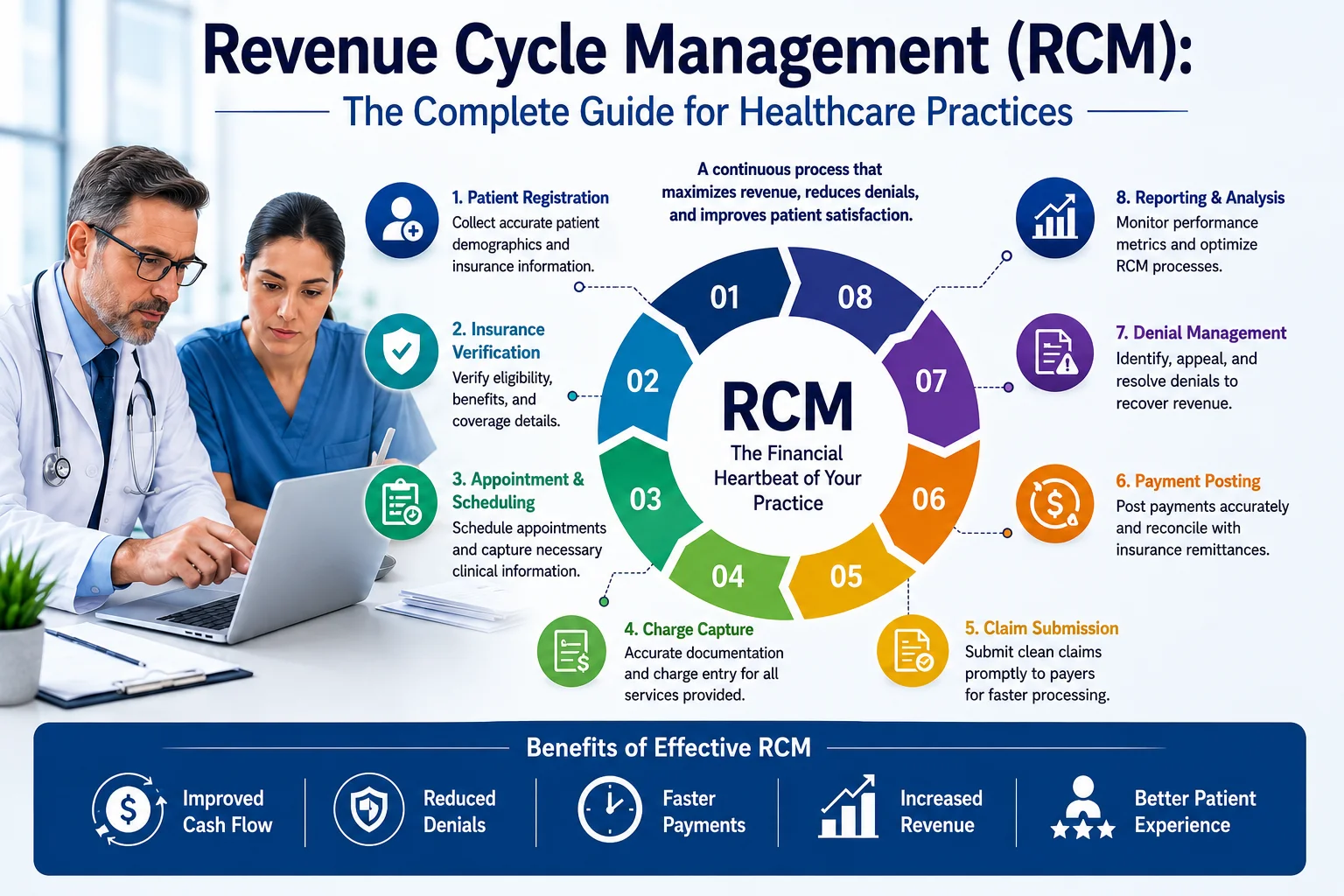
Revenue Cycle Management refers to the administrative and clinical processes that capture, manage, and collect revenue from patient services. It includes various stages from pre-registration through final payment. It integrates clinical documentation, medical coding, claims submission, payer adjudication, patient billing, and collections into one continuous financial workflow.
A common misconception is that Revenue Cycle Management is just medical billing. It is not. Billing is a step inside the revenue cycle. RCM is the entire system that includes the strategy, the staffing, the technology, the metrics, and the continuous improvement that keeps it running. It connects both clinical and financial sides of healthcare.
The healthcare Revenue Cycle management process ensures:
- Patient information is accurate
- Insurance eligibility is verified
- Claims are submitted correctly
- Payments are tracked
- Outstanding balances are collected efficiently.
When all these processes work together, providers can give more time to their patients and less time to collect money.
Why Is Healthcare Revenue Cycle Management Important?
It’s 2026, now insurance companies have introduced stricter documentation requirements, government regulations are continuously updated, and patients are taking on a larger share of healthcare costs through deductibles and coinsurance. The No Surprises Act has introduced new rules around out-of-network billing. At the same time, staffing shortages and administrative burdens have increased.
Each of these changes creates new ways for claims to fail until the system gets updated. Following these regulations, the healthcare revenue cycle becomes a challenge to manage. But all of these challenges are addressable only with the right RCM strategy.
What Are the Stages of Revenue Cycle Management?
RCM consists of three broad stages, including front-end (pre-service), mid-cycle (service and documentation), and back-end (billing, collections, and analysis). Each stage plays its role and any error leads to revenue leakage.
Stage 1: Front-End (Pre-Service)
One of the biggest misconceptions about healthcare Revenue Cycle Management is that it begins after a patient receives treatment. But it started when a patient contacted your practice. This is where most revenue cycle problems are either prevented or created.
Patient Registration and Demographics
Accurate patient information, including name, date of birth, address, and insurance ID, is the foundation of a clean claim. Errors here spread through the entire cycle. A single digit missing in the policy number can cause a denial that takes weeks to resolve.
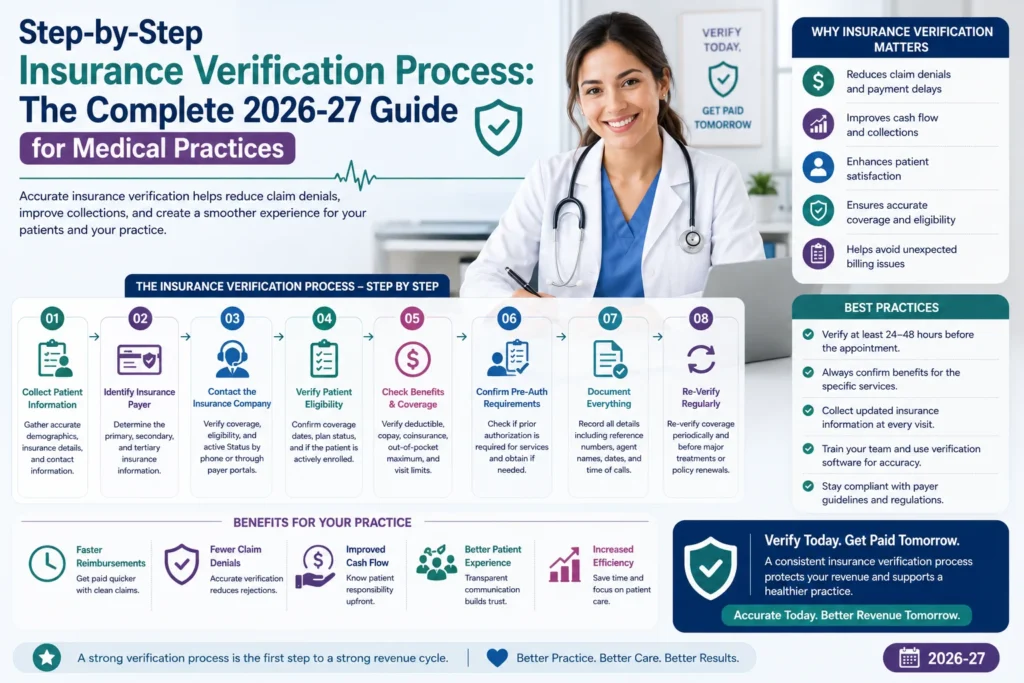
Insurance Eligibility Verification
Before every appointment, staff should confirm that the patient’s insurance is active, that the provider is in-network, and that the planned services are covered. These eligibility issues are preventable. Real-time eligibility verification tools can automate this check and identify problems before the patient arrives.
Prior Authorization
Certain procedures, medications, and specialist visits require payer approval before they happen. The American Medical Association has found that the majority of physicians say prior authorization causes care delays, and some authorization requests are automatically rejected. Practices that track authorization requirements by payer and procedure type and if possible, automation can avoid a huge source of denials.
Patient Financial Counseling
Patients who understand their cost responsibility before receiving care are more likely to pay. Point-of-service collections are a powerful tool: top-performing organizations collected 28.4% of revenue at the point of service in 2025, compared to the median of 16.4%. That gap represents real dollars.
Stage 2: Mid-Cycle (Clinical Documentation and Coding)
This stage connects both clinical care to financial reimbursement. Your documentation must be complete, accurate, and compliant. And coding must match what was actually done.
Clinical Documentation
Every service rendered must be documented in detail to support the codes assigned to it. If you make vague documentation and use phrases like see prior notes or non-specific diagnoses, this can create medical necessity denials and audit risk. Providers should be trained on documentation standards, not just clinical best practices.
Medical Coding (ICD-10 and CPT)
ICD-10 diagnosis codes and CPT procedure codes translate clinical work into billable claims. Some common coding errors, including undercoding, overcoding, or mismatched code combinations are one of the major reasons for denials and compliance risk. Coding-related denials increased and hospital outpatient coding denials also rose. That’s why certified coders and regular audits become necessary parts of risk management.
Charge Capture
Every service performed must have a corresponding charge entered into the billing system. Missed charges are a common form of revenue leakage. It happens when providers fail to document services, when order sets don’t activate charges automatically, or when charge entry workflows are inconsistent. Regular charge capture audits can identify patterns of missed revenue.
Stage 3: Back-End (Billing, Collections, and Analysis)
In this stage, documentation and codes are converted into actual payments. Claims are submitted, decided, appealed, and finally settled at this phase.
Claims Submission and Scrubbing
Before a claim is submitted to a payer, it should pass through a claim scrubber that checks for common errors, including missing modifiers, invalid code combinations, incorrect payer formatting, and demographic mismatches. When a claim is filed correctly, it is reviewed and reimbursed more quickly, usually in 14 to 30 days.
Claims with errors are rejected or denied and rework means more cost and extended days in A/R.
A clean claim rate of more than 90% should be the goal of practices. Best-in-class operations achieve 95% or higher.
For a detailed breakdown of how to get there, see our guide: How to Improve Clean Claim Rate in Healthcare.
Denial Management
When a claim is denied, the practice has two options: whether to appeal or write it off. Best practice is to appeal. Research shows that 67% of denied claims are eligible for successful appeal, yet many practices fail to pursue them due to staffing limitations or a lack of denial tracking processes. Every unworked denial is your revenue loss.
Effective denial management requires you to first categorize denials by reason code, then identify root causes, implement required fixes, and track appeal success rates. Denials are data points that show systemic issues rather than merely a single occurrence.
Payment Posting
When a payer remits payment, that payment must be accurately posted to the correct account, with the correct contractual adjustment applied. Errors in payment posting can lead to incorrect patient statements, distort A/R reporting, and cause compliance problems if contractual adjustments are misapplied.
Patient Billing and Collections
After insurance has paid its portion, the patient’s balance must be calculated accurately and presented clearly. Patient-friendly billing, like transparent statements, easy payment options, digital portals, and payment plans, significantly improves collection rates. Patient collection rates have fallen nationally, which means the practices that invest in the patient billing experience gain a meaningful competitive and financial advantage.
Accounts Receivable (A/R) Management
Outstanding balances must be actively worked on. Claims that age beyond 90 days become increasingly difficult to collect. Regular A/R aging reports should be reviewed at least monthly, with systematic follow-up protocols for each payer and for patient balances. Target Days in A/R below 40 for most practice types.
For a complete breakdown of how to interpret and optimize this metric, read our guide: Days in Accounts Receivable (A/R): Complete Guide.
Reporting and Continuous Improvement
RCM is not just a one-time process that you’ve done and forgotten. Regular analysis of performance indicators, including denial rates, clean claim rates, Days in A/R, net collection rate, and cost to collect, enables practice leaders to identify trends, find problems early, and drive continuous improvement. Practices that evaluate RCM data consistently perform better than those that address issues after they have become worse.
What Causes Revenue Leakage in Healthcare?
Revenue leakage refers to billable revenue that is generated through clinical services but never collected, not because it was uncollectable, but because breakdowns in the revenue cycle allowed it to slip through.
Leakage is not always visible on a single report. It accumulates across dozens of small failures like a missed prior authorization here, an unbilled procedure there, a denial that was never appealed, a charge that was never entered. Individually, these seem minor.
The most common sources of leakage in medical practices include:
- Eligibility errors are causing front-end denials that are never reworked
- Charge capture gaps where services rendered are not billed
- Coding errors leading to underpayment or denial
- Missed or expired prior authorizations resulting in medical necessity denials
- Unworked denials that are written off instead of being appealed
- Patient balance write-offs from poor upfront financial counseling
- Contractual underpayments that are never identified through payment variance analysis
For a complete analysis of how and where practices lose revenue, read: Top Causes of Revenue Leakage in Medical Practices.
Should You Outsource Revenue Cycle Management?
One of the most consequential decisions a healthcare practice faces is whether to manage revenue cycle functions in-house, outsource to a specialized RCM medical billing partner, or use a hybrid approach.
The answer depends on the practice’s needs, size, specialty, payer mix, existing staff skills, and the practice’s strategic growth trajectory.
In-House RCM: Gives you control and direct oversight but requires continuous investment in staff training, technology, compliance monitoring, and management bandwidth. It works best when the practice has a dedicated, experienced billing team and stable, low-complexity billing.
Outsourced RCM: Allows practices to access specialized expertise, advanced technology, and scalable capacity without building those capabilities internally. The best RCM partners provide you with denial prevention, coding compliance, and A/R management capabilities that would be costly to replicate. You have full access to your billing operations but if the relationship is not managed actively, then it may cause some visibility issues. But outsourcing gives you the peace of mind you actually need to provide the best patient care.
Hybrid models: Where the practice handles patient scheduling and registration while outsourcing some of its operations to an experienced medical billing company, like claims, coding, and denial management, which are increasingly common and often the most important for mid-sized practices.
All the options are convenient depending on your practice but remember, whatever option you choose, the revenue cycle KPIs benchmarks are the same. Performance data should be transparent, regularly reviewed, and tied to clear improvement goals.
How can Revantage Billing help you?
Revenue cycle management is not any easy task that everyone can do. It requires expertise, accuracy, and continuous attention to detail. That’s why providers prefer an experienced medical billing company, Revantage Billing. We help healthcare practices simplify their billing processes, reduce claim denials, improve clean claim rates, and accelerate reimbursements.
Our experienced team of medical billers and coders knows how to handle the stages of Revenue Cycle management from insurance verification and medical coding to claims management, payment posting, and accounts receivable follow-up.
If you are ready to strengthen your revenue cycle, contact Revantage Billing today for a free consultation at: +1 945 206 – 7001 and discover how our customized medical billing solutions can support your practice’s long-term financial success.