Medical claim denials are one of the biggest challenges healthcare providers face today. Even when services are medically necessary and properly documented, claims can still be denied due to coding errors, payer policies, missing information, or billing mistakes.
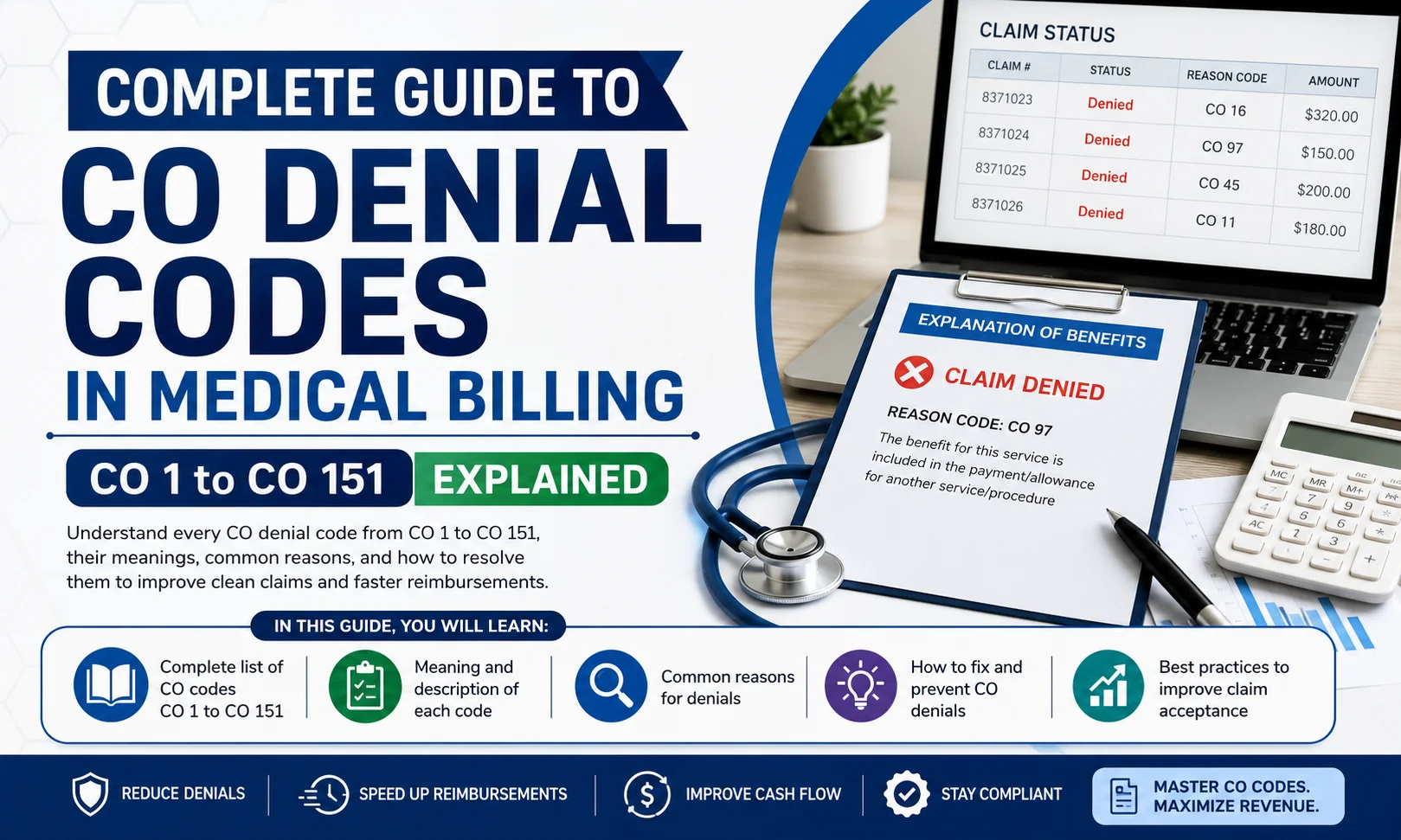
And the most common denial categories are CO denial codes, also known as Contractual Obligation denial codes. These codes tell providers why a claim was denied or adjusted and indicate that the provider is financially responsible for the adjustment.
Reducing claim rejections, increasing reimbursement rates, and preserving a strong revenue cycle in 2026 all depend on an understanding of CO denial codes. Let’s talk about the most common CO denial codes, their causes, and the best ways to avoid them.
What Are CO Denial Codes in Medical Billing?
The word CO stands for Contractual Obligation.
When a payer assigns a CO denial code, it means the adjustment is the provider’s responsibility according to the contract between the healthcare provider and the insurance company.
Unlike PR (Patient Responsibility) codes, CO adjustments generally cannot be billed to the patient.
Why CO Denial Codes important
CO denial codes can cause:
- Revenue loss
- Delayed reimbursements
- Increased administrative workload
- Higher accounts receivable balances
- Reduced clean claim rates
That’s why medical billers and revenue cycle teams must understand these denial codes and know how to resolve them quickly.
CO 1 Denial Code Explained
CO 1: Deductible Amount
CO1 denial code indicates that a portion of the claim has been applied toward the patient’s deductible.
Most insurance plans require patients to meet an annual deductible before the insurance company starts paying for covered services.
If the deductible has not been met, the payer applies the amount toward the deductible.
Example
A $200 claim is submitted by a provider.
The patient’s annual deductible is still $500.
After processing the claim, the insurance designates CO 1 for the $200.
How to Resolve It
- Verify patient benefits before service.
- Collect estimated deductible amounts upfront.
- Review the Explanation of Benefits (EOB).
- Bill the patient if allowed under the plan.
Prevention Tips
First check eligibility verification and use real-time insurance checks. It is also important to educate patients about deductible responsibilities.
CO 4 Denial Code Explained
CO 4: Procedure Code bill does not match the Modifier Used or the Required Modifier Missing
This code occurs when a CPT code is billed with an incorrect modifier or a required modifier is missing.
Common causes include:
- Missing modifier 25
- Missing modifier 59
- Incorrect modifier usage
- Coding software errors
Example
An E/M service and procedure are performed on the same day.
The claim is submitted without Modifier 25.
The payer denies part of the claim under CO 4.
How to Resolve It
- Review coding guidelines.
- Add the appropriate modifier.
- Correct and resubmit the claim.
Prevention Tips
If you never want to make this inconsistency, then train your coding staff regularly and conduct coding audits. For more accuracy, you can use coding validation software.
CO 11 Denial Code Explained
CO 11: Diagnosis Inconsistent with Procedure
The diagnosis code does not support medical necessity for the procedure billed.
Insurance companies use medical necessity rules to check whether a service is appropriate for a specific diagnosis.
Example
A provider bills a diagnostic test that is not covered for the diagnosis submitted.
The payer denies the service using CO 11.
How to Resolve It
- Check the accuracy of the diagnosis.
- Review the NCD and LCD guidelines.
- If necessary, submit updated diagnosis codes.
Prevention Tips
Use diagnosis-to-procedure validation tools instead to avoid this. Keep up with payer policy and inform providers of documentation requirements.
CO 12 Denial Code Explained
CO 12: Invalid Diagnosis Code
This denial occurs when the diagnosis code submitted is invalid, outdated, incomplete, or incorrect. Some common causes of CO 12:
- Deleted ICD-10 codes
- Incorrect character count
- Missing specificity
- Typographical errors
Example
A claim is submitted using an outdated ICD-10 code that was discontinued during an annual update.
How to Resolve It
- Review coding updates.
- Correct the diagnosis code.
- Refile the claim.
Prevention Tips
Update coding software regularly. Try to do claim scrubbing before submission and must train coders on ICD-10 updates.
CO 15 Denial Code Explained
CO 15: Authorization Number Missing, Invalid, or Does Not Apply
This denial occurs when prior authorization information is missing or invalid.
Many services require pre-authorization, including:
- Advanced imaging
- Surgeries
- Specialty treatments
- Durable medical equipment
Example
An MRI is performed without obtaining prior authorization.
The claim is denied under CO 15.
How to Resolve It
- Verify authorization requirements.
- Obtain retro authorization if allowed.
- Submit the corrected claim.
Prevention Tips
To fulfil authorization requirements, create authorization workflows and verify requirements before appointments. Track authorization expiration dates.
CO 16 Denial Code Explained (Very High Search Volume)
CO 16: Claim Lacks Information Needed for Adjudication
This is one of the most frequently searched and most common denial codes in medical billing.
It means the payer does not have enough information to process the claim. Common Reasons for CO 16 Denials include:
- Missing medical records
- Missing modifiers
- Missing provider information
- Missing NPI number
- Incomplete claim forms
- Missing accident details
- Missing authorization information
CO 16 denials often represent avoidable revenue leakage. Many healthcare organizations see great improvements in collections simply by reducing CO 16 errors.
Example
A provider submits a claim but forgets to include a required modifier.
The payer cannot process the claim and issues CO 16.
How to Resolve CO 16
- Review the Remittance Advice (RA).
- Check Remark Codes (RARC).
- Identify missing information.
- Correct the claim.
- Submit documentation.
- Resubmit the claim.
Best Prevention Strategies
To prevent this, use claim scrubbing software and verify all claim fields before submission. You also need to conduct front-end eligibility verification. Perform routine billing audits for better results in the future.
CO 18 Denial Code Explained
CO 18: Duplicate Claim or Service
The payer believes the service has already been billed. Some common causes include:
- Claim submitted twice
- Corrected claim submitted incorrectly
- Duplicate electronic transmissions
- Resubmission without proper indicators
How to Resolve It
- Verify whether the payment was already made.
- Review claim history.
- Submit corrected claim documentation if necessary.
Prevention Tips
First you need to track claim submissions. Prefer to use clearinghouse reports and avoid unnecessary resubmissions.
CO 19 Denial Code Explained
CO 19: Procedure Code Missing or Invalid
CO 19 is used when the procedure code billed is invalid or missing. Some common causes include:
- CPT coding errors
- HCPCS coding mistakes
- Deleted procedure codes
- Missing procedure code entry
How to Resolve It
- Verify CPT code accuracy.
- Update coding references.
- Resubmit the corrected claim.
CO 20 Denial Code Explained
CO 20: Injury or Illness May Be Work-Related
The payer suspects workers’ compensation should be responsible for payment.
The diagnosis indicates a potential work-related injury.
How to Resolve It
- Verify accident details.
- Determine workers’ compensation involvement.
- Submit appropriate documentation.
Prevention Tips
Collect accident information during registration and ask detailed injury-related questions.
CO 22 Denial Code Explained
CO 22: Payment Adjusted Due to Coordination of Benefits
CO 22 is used when another insurance carrier is responsible for payment. Common causes include:
- Incorrect primary insurance
- Missing secondary insurance information
- COB information not updated
How to Resolve It
- Verify insurance order.
- Update coordination of benefits.
- Submit a claim to correct the payer.
CO 27 Denial Code Explained
CO 27: Expenses Incurred After Coverage Terminated
The patient’s insurance coverage was inactive on the date of service. Some common causes of CO 27 include:
- Insurance terminated
- Eligibility not verified
- Incorrect coverage dates
How to Resolve It
- Verify eligibility.
- Obtain updated insurance information.
- Bill the correct payer if applicable.
Prevention
Always perform eligibility checks before every visit.
CO 29 Denial Code Explained
CO 29: Time Limit for Filing Has Expired
This is a timely filing denial. And this is used when the claims were submitted after the payer’s filing deadline. The claim filing limits are 90, 180, and 365 days, depending on the payer’s policy.
How to Resolve It
- Review filing deadlines.
- Provide proof of timely filing.
- Appeal if documentation supports timely submission.
Prevention Tips
If you want to submit a claim on time, then monitor aging claims. Use automated claim tracking systems and set benchmarks for claim submission.
CO 31 Denial Code Explained
CO 31: Patient Cannot Be Identified as Insured
The payer cannot match the patient to an active member record. Some common causes of CO 31 include:
- Incorrect member ID
- Misspelled patient name
- Incorrect birth date
- Coverage mismatch
How to Resolve It
- Verify demographic information.
- Correct errors.
- Resubmit the claim.
CO 45 Denial Code Explained
CO 45: Charge Exceeds Fee Schedule or Maximum Allowable Amount
This is one of the most common contractual adjustment codes. It is used when the provider billed more than the payer’s contracted allowed amount.
Example
Provider Charge: $250
Contracted Allowed Amount: $175
The $75 difference is adjusted using CO 45.
Prevention
Understand payer fee schedules and regularly review contract rates.
Important Note
This is typically not a true denial but a contractual adjustment.
CO 50 Denial Code Explained
CO 50: Medical Necessity Not Met
The CO 50 applied when the payer determined the service was not medically necessary. Some common causes include:
- Insufficient documentation
- Unsupported diagnosis
- Failure to meet coverage criteria
Resolution
- Review payer policy.
- Submit supporting medical records.
- Appeal if medically justified.
Prevention
You need to strengthen provider documentation and follow LCD and NCD guidelines.
CO 59 Denial Code Explained
CO 59: Processed Based on Multiple or Concurrent Procedure Rules
CO 59 is used when the payer reduces payment according to multiple procedure payment policies.
When multiple procedures are performed during the same encounter, payers often reimburse the primary procedure at 100% and secondary procedures at reduced rates.
Resolution
- Verify coding accuracy.
- Review payer payment methodology.
Prevention
Ensure correct procedure sequencing and apply modifiers appropriately.
CO 96 Denial Code Explained
CO 96: Non-Covered Charge(s)
The service provided is not covered under the patient’s health plan. Some common causes include:
- Excluded benefits
- Cosmetic services
- Experimental procedures
- Non-covered treatments
Resolution
- Verify benefits.
- Obtain ABN when applicable.
- Appeal if coverage exists.
Prevention
Conduct benefit verification before treatment and educate patients regarding coverage limitations.
CO 97 Denial Code Explained (Very High Search Volume)
CO 97: Payment Included in Another Service or Procedure
This denial is commonly referred to as a bundling denial. It happens when the payer believes the service billed separately is already included in another procedure that was paid for:
- E/M services bundled into procedures
- Laboratory services bundled together
- Surgical package billing
- Global period restrictions
This is very important because CO 97 denials account for millions of dollars in lost revenue annually across healthcare organizations.
Understanding bundling rules can greatly improve reimbursement performance.
Example
A provider bills a minor procedure and an office visit. The office visit does not qualify for separate reimbursement.
The payer bundles the E/M service into the procedure and assigns CO 97.
How to Fix CO 97 Denials
- Review NCCI edits.
- Verify modifier usage.
- Use Modifier 25 when supported.
- Use Modifier 59 when appropriate.
Prevention Tips
To prevent CO 97, follow CMS bundling rules. Conduct coding audits and train your coding staff regularly.
CO 109 Denial Code Explained
CO 109: Claim Not Covered by This Payer or Contractor
CO 109 is used if the claim was submitted to the wrong insurance carrier. Some common reasons for CO 109 include:
- Incorrect payer selection
- Outdated insurance information
- COB errors
Resolution
- Verify payer information.
- Submit a claim to the correct insurer.
CO 151 Denial Code Explained
CO 151: Payment Adjusted Because the Payer Deems the Information Submitted Does Not Support This Many/Frequency of Services
The payer believes services were provided too frequently. Common causes include:
- Frequency limitations exceeded
- Duplicate service dates
- Documentation is insufficient to justify repeated services
Example
Physical therapy visits exceed payer frequency limits.
The payer issues CO 151.
How to Resolve It
- Review payer frequency guidelines.
- Submit supporting documentation.
- Appeal when medically necessary.
Prevention Tips
Track visit utilization and verify coverage limitations before treatment.
How to Reduce CO Denial Codes in Medical Billing
Reducing denial rates starts long before the claim is submitted. Successful healthcare organizations focus on:
- Insurance eligibility verification
- Prior authorization management
- Accurate medical coding
- Documentation improvement
- Claim scrubbing technology
- Staff training
- Denial trend analysis
- Revenue cycle audits
By addressing issues at the front end, providers can prevent many CO denials before they occur.
Why Healthcare Providers Trust Revantage Billing for Denial Management
Managing denial codes can be time-consuming, but you don’t have to handle them alone. At Revantage Billing, we help healthcare providers reduce claim denials, improve first-pass claim acceptance rates, and maximize reimbursements through accurate medical coding, proactive denial management, and complete revenue cycle management solutions.
Our experienced medical billing specialists stay updated with the latest payer guidelines and industry regulations. Whether you’re struggling with CO 16, CO 97, or any other denial code, Revantage Billing provides the expertise and support you need to keep your revenue cycle consistent.